Shortly after the 2024 Land Law took effect, the National Assembly has once again become a hotbed of debate over plans to amend this vital piece of legislation.
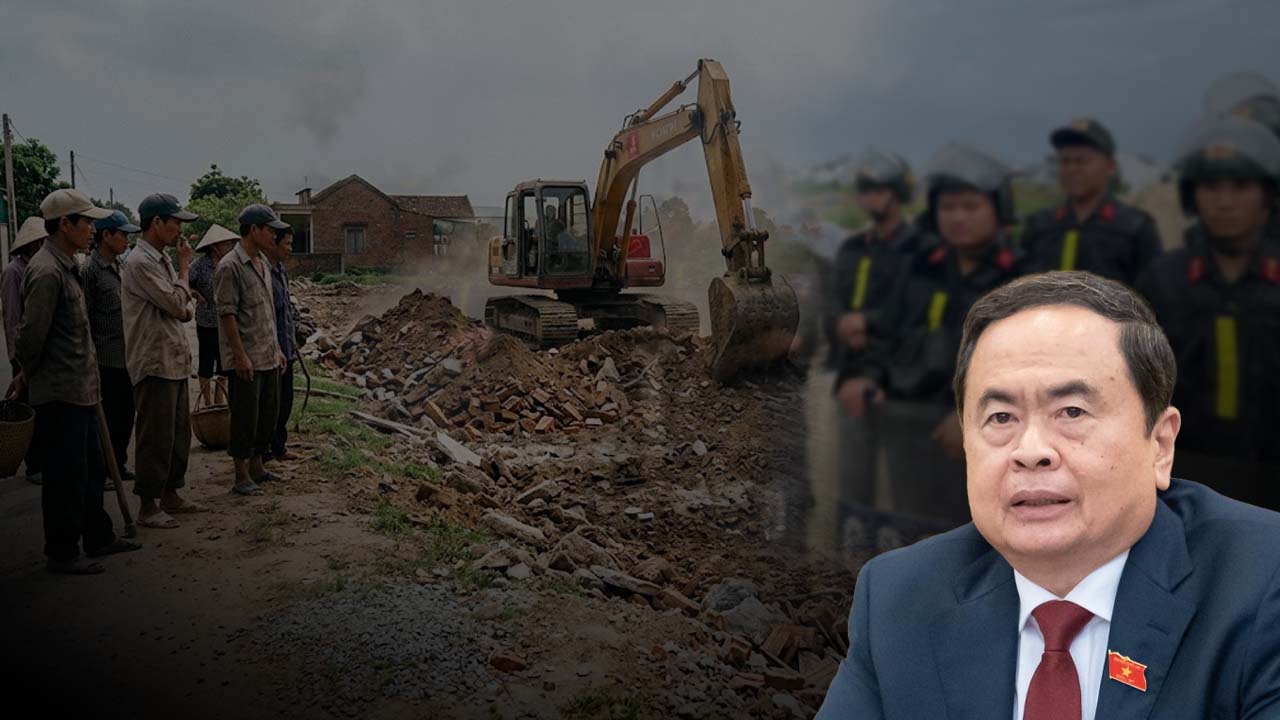
This amendment is expected to be submitted to the National Assembly for approval at its second session in October 2026. The current draft amendment to the Land Law poses a major challenge regarding public trust.
It is understood that the core principle—“land belongs to the entire people, with the State acting as the representative owner and exercising unified management”—has once again become the basis for expanding the authority of the administrative apparatus.
Behind the policy of removing bottlenecks and accelerating project progress for economic development, the draft amendment reveals a trend toward maximizing public authority in land expropriation and determining the value of citizens’ assets.
Notably, a series of cases for land expropriation have been added under the guise of meeting requirements “for the national interest or the public good.”
This list now extends beyond urgent public investment projects or the establishment of additional free trade zones aimed at promoting growth and attracting foreign investment.
The authority to expropriate land has also been expanded for national defense and security purposes—which, in essence, represents a significant broadening of the state’s authority over citizens’ property.
State intervention is also clearly evident in the vague mechanisms for land expropriation related to economic projects and urban renewal.
Although the previous 2024 Land Law had rejected a proposal allowing the state to “intervene when a business has only secured an agreement for a portion of the land area,” this amendment surprisingly reintroduces that provision.
Accordingly, the drafting agency has proposed two consent thresholds—75% or 85%—while the government has publicly favored the 75% figure, citing the need to prevent waste and address stalled projects.
It is reported that the shift from a civil agreement to enforcement through state power once the 75% threshold is reached is facing fierce opposition even within the National Assembly itself.
When the state steps in to enforce the agreement while the remaining 25% of residents have not yet consented, the line between agreement and property expropriation can easily become blurred.
According to international observers, if the actual scale—particularly regarding residential land—is not taken into account, this mechanism risks turning the state into a tool for land expropriation on behalf of “interest groups,” namely private investors.
In recent decades, land expropriation has consistently been the root cause of protracted legal disputes, even escalating into painful lessons such as those in Tiên Lãng, Thủ Thiêm, and most recently, Đồng Tâm.
However, instead of thoroughly resolving these conflicts, the 2024 draft amendment to the Land Law proposes a deeply alarming “step backward.”
Specifically, it allows for land expropriation before the compensation plan, resettlement support, and the arrangement of new housing have been approved and finalized.
Meanwhile, current regulations require the government to seek public input and complete compensation and resettlement before expropriation to protect citizens.
Reversing this process will place citizens in a completely passive position. They must surrender their land and relocate before knowing how much compensation they will receive or where they will live.
Furthermore, the situation becomes even bleaker as the principle of determining land prices based on market value is discarded in favor of a state-determined land pricing mechanism.
When the government holds complete control—from the right to expropriate, the right to set the handover date, and even the right to determine compensation amounts—the balance of interests has shifted entirely to one side, creating a highly dangerous inequality.
The insecurity surrounding property rights among the majority of the population will inevitably give rise to new and more intense social flashpoints in the future.
Trà My – Thoibao.de