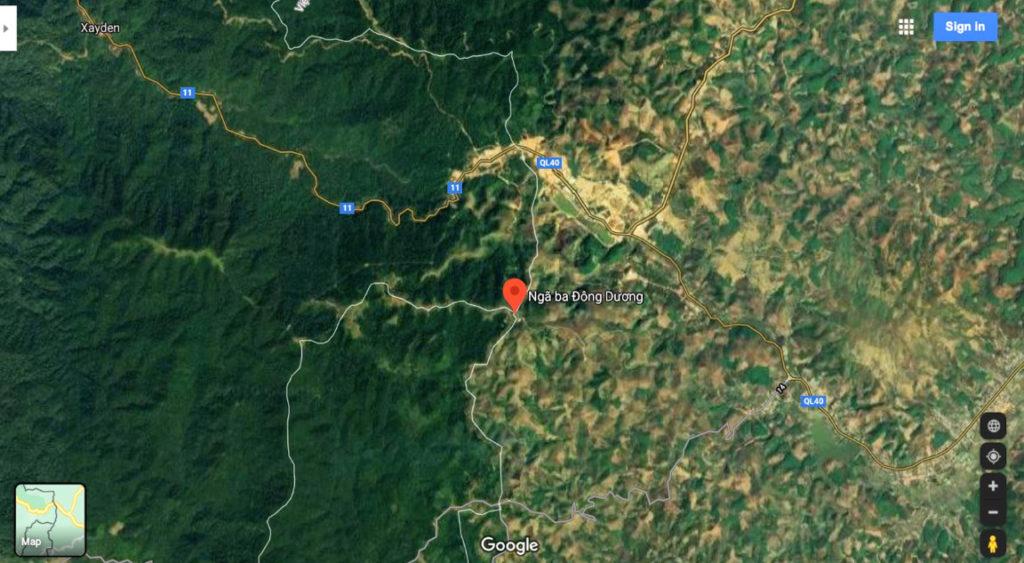
Regarding the rescue of 26 missing people from 2 Binh Dinh fishing boats that sunk while fleeing the storm, the media reported that the aircraft was searching but could not find them.

Previously, there was a rumor from social media that 26 fishermen had been contacted, but Tuoi Tre newspaper said that it was inaccurate.

At noon and in the afternoon of October 27, there was news that these 26 fishermen were missing, but it was not until 1.37 pm of October 28 that the DHC-6 seaplane went to search for 1.5 hours but there was no result. .

Hình ảnh này chưa có thuộc tính alt; tên tệp của nó là 2020-10-30_091008-1024x576.jpg
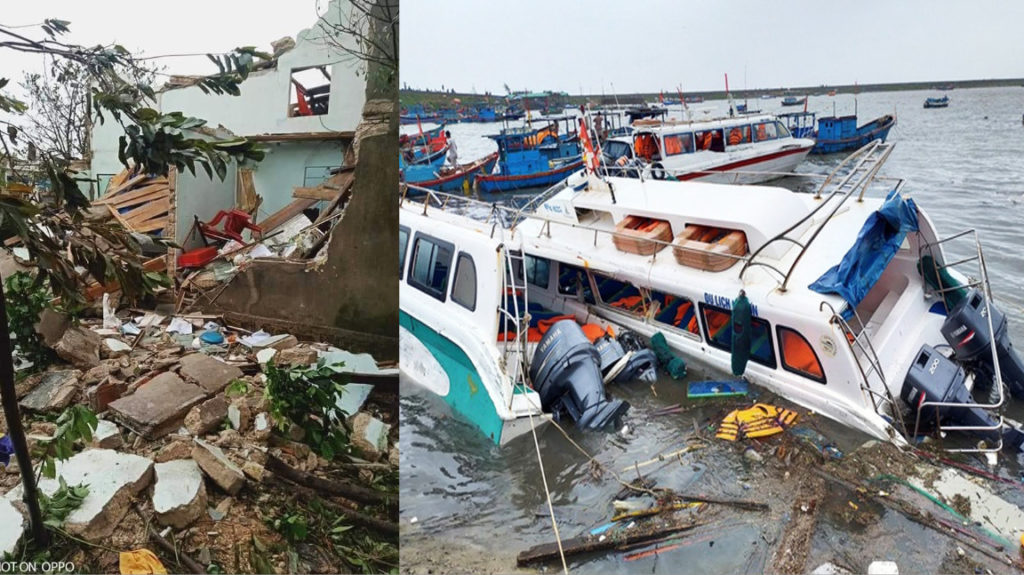
The house roof was flying, the trees fell everywhere in Quang Ngai and Danang on October 28 due to typhoon Molave

Typhoon Molave made landfall on October 28 morning in localities from Danang to Phu Yen that weakened to tropical pressure on the afternoon of October 28.

The typhoon left the coastal area and went to the west of the Central Highlands, in the southwestern region of Quang Nam, which borders Laos.

Heavy rains began to rain in Gia Lai, Kontum, Quang Nam and Thua Thien-Hue provinces.

Initial damage showed that 3 people died, 28 victims were missing; tens of thousands of houses had their roof blown off; 1.7 million houses lost power; hundreds of trees were broken, fell and two fishing boats were lost.

Out of more than 56,000 houses whose roofs were blown off, over 53,000 are in Quang Ngai. In addition, 1.7 million homes were out of power and hundreds of trees were broken or fallen. Statistics show that typhoon Molave destroyed 34 houses: 9 in Quang Ngai, 23 in Binh Dinh, 1 in Phu Yen, and 1 in Gia Lai.

In Kontum, a bridge in Kon Ray district was washed away, isolating 115 households with 680 people in village 11, Dac Ruong commune.

The Vietnam National Center for Hydrometeorological Forecasting on the afternoon of October 28 said that flood water levels on rivers from Quang Tri province to Binh Dinh, Gia Lai and Kon Tum were rising. During the next 12 hours, floods on Thach Han River, Quang Tri Province may rise above alarming level 2; the water level of Vu Gia river in Quang Nam, and Tra Khuc river  and Ve river in Quang Ngai rose above alarm level 3.

Notably, the flood peak on Dakbla river (Kon Tum) can be up to 522.5 m – nearly 2 meters above alarm 3.

The Meteorological Agency warns of a very high risk of flash floods, landslides in mountainous areas and urban and low-lying floods in the provinces from Thua Thien-Hue to Binh Dinh and the northern Central Highlands.

The flood washed away the bridge, making thousands of people in Kon Tum isolated

Hình ảnh này chưa có thuộc tính alt; tên tệp của nó là 2020-10-30_091057-1024x575.jpg
The iron bridge in Dac Pne commune, Kon Ray district, Kon Tum province was swept away, making 3 villages with 1,500 people isolated

In Gia Lai, typhoon Molave speeded up the roofs of 21 houses and schools in the districts of Chu Se, Ia Hiao, and Krong Chro.

Meanwhile, in Kon Tum, storms caused National Highway 24 and Highway 26 through Kon Plong district to be flooded, and vehicles could not move. At present, Mang Canh commune, Kon Plong district with thousands of people has been isolated because provincial Road 676 is deeply flooded.

Large floods also appeared in Kon Ray district, Kon Tum province, swept away the iron bridge connecting Dak Pne commune with the district center, making 1,500 people isolated.

Mr. Hoang Trung Thong, chairman of Dak Glei District People’s Committee, said heavy rains also made provincial Road 673 and Ho Chi Minh Road, many landslide points made Dak Plô and Ngoc Linh communes isolated.

Many ships in Ly Son island were sunk by storms: After Molave swept Ly Son island district (Quang Ngai), many houses collapsed, people’s boats and fish cages were damaged, many ships were damaged, causing great damage.

The railway is paralyzed: Mr. Le Hong Son, deputy director of Nha Trang Railway Transport Branch (Khanh Hoa), said that Molave caused trees to fall into the rails so railway traffic was paralyzed.

Quang Tri Hydropower discharges floods from 3 pm on October 28, meanwhile, it is expected that there will be a heavy rain on a large scale in this locality due to the impact of Molave.

Quang Tri Hydropower Company will carry out flood discharge from 3 pm of October 28. The announced initial flood discharge volume is 40 cubic meter/s. It is then regulated according to the actual flood flow to the lake.

Quang Tri Hydropower Plant is operated by Quang Tri Hydropower Company, which is the largest hydroelectric power plant in Quang Tri province with a design capacity of 64MW.

Hình ảnh này chưa có thuộc tính alt; tên tệp của nó là 2020-10-30_091125-1024x576.jpg
Dak Mi 4 Hydropower Plant is expected to discharge 11,400 cubic meters/s. Quang Nam and Danang are facing flooding

The high risk of flash floods and landslides in the mountainous areas of Huong Hoa, Dakrong, Cam Lo districts, the western communes of Vinh Linh, Gio Linh and Hai Lang districts; landslide along rivers and streams, roads and works under construction.

In the delta area, the risk of flooding and inundation in low-lying areas is Vinh Linh, Gio Linh, Trieu Phong, Cam Lo, Dong Ha city, Quang Tri town and Hai Lang district.

Dak Mi 4 Hydropower is expected to discharge 11,400 cubic meters/s. Quang Nam and Danang faces flooding

At 3.30 pm of October 28, Dak Mi 4 Hydropower Company (Quang Nam) announced a second flood discharge adjustment with an expected flow of 11,400 cubic meters. It is forecasted that in the next 6-12 hours, the water level on Vu Gia river will rise to alarm 3, nearly half a meter above historical level.

According to the announcement of the Dak Mi Hydropower Joint Stock Company, it is expected that at 3.30 pm, the Dak Mi 4 hydropower reservoir will start to increase the second flood discharge, the discharge is expected to reach 11,400 cubic meters/s.

In the case of the Dak Mi 4 hydropower discharge downstream as expected 11,400 cubic meters, in the next 6-12 hours, the water level on the Vu Gia river at Ai Nghia station is likely to rise to 11.2 m, the water level will exceed the historic flood level in 2009 by about 0.5 m.

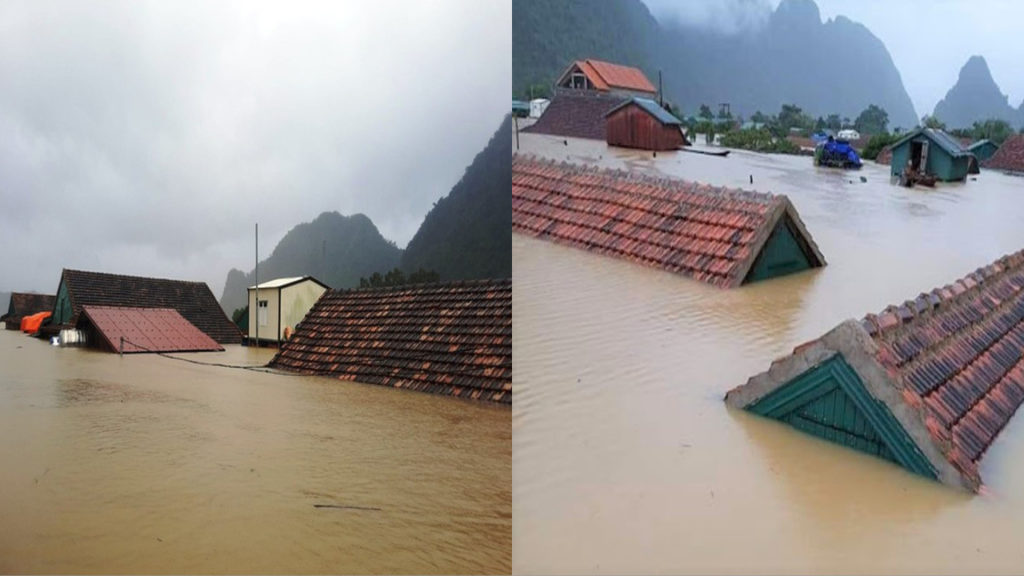
The risk is very high causing deep flooding, large area low-lying areas and landslides in districts: Nam Giang, Dai Loc, Dien Ban, Duy Xuyen, Hoi An city (Quang Nam), Da Nang city.

The National Center for Meteorological and Hydrological Forecasts warns that level 4 natural disaster risk caused by flood, inundation, and landslides is the highest level of risk.

Regarding singer Thuy Tien’s reputation for charity work to aid flooded people and her trust money soaring, Radio Free Asia conducted a three-day survey.

Hình ảnh này chưa có thuộc tính alt; tên tệp của nó là 2020-10-30_091150-1024x556.jpg
Summary of survey results from Free Asia station for the question “who would you like to contribute flood relief money to or which organization”

The results showed that only 1.3% of respondents wanted to transfer relief money to the Fatherland Front.

A survey by Radio Free Asia from October 24 to October 27, 2020, asking “who or which organization do you want to donate money to flood victims” shows: only over 1% of Respondents agreed to transfer money to the Fatherland Front, while nearly 92% of people wanted to transfer money to singer Thuy Tien.

Specifically, the survey of Radio Free Asia on Fanpage took place for 3 days, 775,031 people approached the post, of which a total of 25,761 people participated in the survey by clicking on emoticons.

There were 23,261 respondents who agreed to transfer money to help the people of Central Vietnam to singer Thuy Tien, 560 people chose YouTuber Khuong Dua with the rate of 2.2%.

Notably, the Red Cross, the Fatherland Front and VTV station only received 3.7%, 1.3% and 0.3%, respectively.

Some commenters said they would transfer relief money to people they trust, such as local religious organizations, to provide relief on their behalf.

So far, singer Thuy Tien has received about VND150 billion to aid the people, while the leader of the Fatherland Front advised her to share this money with the Red Cross.

FB Do Vu said: “She caused a deep divide between the People and the Vietnam Fatherland Front which is often difficult to recognize!”

FB Bui Phi Hung replied: “Well, the old lesson of corruption from the shops, the cadres class in all regions, the position is still abundant; Which is the Nurturing center for the elderly and disabled children right in Hanoi, the charity house, the education center, commune, district, province … to corrupt without leaving anything, regardless of the situation, circumstances … “

FB Hoang Tam Bui: “Singer Thuy Tien has the great merit to people in flooded areas because she has mobilized more than VND150 billion to support people. But how does Thuy Tien have even greater merit to the Vietnamese environment in helping them realize their position in the hearts of the people?”

Before many forecasts of Molave ​​storms with the power equivalent to typhoon Damrey in 2017, people in the Central region held their breath and prayed before Molave hurricane just landed this afternoon.
Hình ảnh này chưa có thuộc tính alt; tên tệp của nó là 2020-10-30_091213-1024x575.jpg
In Ly Son island district, many houses were blown off their roofs, flattened on the road, boats were sunk even though they were anchored close to shore

Mr. Nguyen Huynh Son from Phu My district, Binh Dinh province told BBC on the morning of October 28:

“Just hope the storm passes quickly, people have suffered so much pain for a year. Last night, my family waited for the storm because they heard the wind hissing. For many people in the coastal area, temporary houses are not permanent and have made shelter. Other houses do not have conditions, they were built on very fragile foundations and love roofing so they will not be able to withstand this storm. I just hope they are safe.”

Reply to BBC News in Vietnamese on October 28 from Quang Ngai, Mr. Pham The updated:

“From 8 am this morning, the storm has decreased to level 12, but in many places, strong winds knocked trees, signs, and roof and tile roofs blown away like paper.”

People in Quang Nam said that during the night, every 15 minutes, village loudspeakers broadcast emergency news, titled “hurricane Molave,” enough to see the severity of this storm.

Thoibao.de (Translated)

Link Video: https://www.youtube.com/watch?v=OiM2m89Y7PU

Hôm, 23/10/2020, Hoa Kỳ thông báo gởi các tàu tuần tra của lực lượng tuần duyên Mỹ đến vùng Thái Bình Dương để chống lại các hoạt động « gây mất ổn định » của Trung Quốc tại các vùng đánh cá đang có tranh chấp ở Biển Đông.

Theo hãng tin AFP, trong một thông cáo, cố vấn an ninh quốc gia của Nhà Trắng, Robert O’Brien, cáo buộc Bắc Kinh « đánh bắt trái phép » và « sách nhiễu » các tàu cá của những nước láng giềng, đồng thời thông báo là lực lượng tuần duyên đang triển khai các tàu tuần tra nhanh đến khu vực tây Thái Bình Dương.

Ông O’Brien nói rõ là các tàu tuần tra lớp Sentinel sẽ thực hiện nhiệm vụ bảo vệ an ninh hàng hải, nhất là hỗ trợ cho các ngư dân, qua việc cộng tác với các đối tác trong khu vực mà khả năng giám sát biển còn hạn chế. Cố vấn an ninh quốc gia của Nhà Trắng cho biết thêm là lực lượng tuần duyên Mỹ, trực thuộc bộ An Ninh Nội Địa Hoa Kỳ, dự trù sẽ đặt thường xuyên các tàu tuần tra này tại vùng lãnh thổ Samoa của Mỹ, nằm ở vùng nam Thái Bình Dương.

Washington thường xuyên tố cáo Bắc Kinh vi phạm luật pháp quốc tế khi điều động các chiến hạm để hộ tống những tàu đánh cá của Trung Quốc hoạt động tại ngư trường của các nước khác. Hồi tháng 07/2020, bộ trưởng Quốc Phòng Mỹ Mark Esper đã lên án những hành động của Trung Quốc ở Biển Đông, cáo buộc hải quân Trung Quốc đã đâm chìm một tàu cá Việt Nam, quấy nhiễu các công ty thăm dò dầu khí của Malaysia và hộ tống các tàu cá Trung Quốc vào vùng đặc quyền kinh tế của Indonesia. Vào tháng 09, Jakarta đã phản đối vụ một tàu hải cảnh Trung Quốc xâm nhập vùng đặc quyền kinh tế của Indonesia.

Trong khi đó, hôm qua, Philippines và Nhật Bản đã nhấn mạnh là các quốc gia phải ngưng mọi hoạt động có thể gây thêm căng thẳng ở Biển Đông. Trong một cuộc họp trực tuyến, bộ trưởng Quốc Phòng Philippines Delfin Lorenzana và đồng nhiệm Nhật Nobuo Kishi, cũng đã nêu bật tầm quan trọng của tự do hàng hải tại các vùng tranh chấp ở Biển Đông.

Biển Đông: Mỹ vẫn cứng rắn với Trung Quốc dù tân tổng thống là Biden hay Trump

Ngày 03/11/2020, cường quốc lớn nhất hành tinh sẽ bầu ra một lãnh đạo mới. Kết quả của cuộc bầu cử năm 2020 sẽ có ý nghĩa rất lớn đối với địa chính trị thế giới. Một trong những vấn đề quan trọng mà chính quyền Joe Biden hay Donald Trump nhiệm kỳ II phải xem xét, là chính sách của Mỹ đối với châu Á và Trung Quốc, với một trong những vấn đề nổi côm là Biển Đông.

Điều mà không một ai có thể phủ nhận là với tổng thống Donald Trump và chủ trương gây sức ép toàn diện của ông đối với Trung Quốc, châu Á đã chiếm một vị trí quan trọng trong chính sách đối ngoại của Hoa Kỳ.

Đây là một chuyển biến đã có từ thời chính quyền Obama, với chiến lược xoay trục sang châu Á, nhưng với việc tổng thống Trump nhấn mạnh vào chiến lược Ấn Độ-Thái Bình Dương, chính sách đối ngoại của Mỹ như đã chuyển trọng tâm từ Trung Đông để quay sang tập trung vào châu Á.

Vấn đề mà nhiều nhà quan sát ghi nhận là trong suốt thời kỳ tiền bầu cử tại Mỹ, do việc thái độ cứng rắn đối với Trung Quốc là một chủ đề ăn khách, chính quyền của ửng cử viên Trump đã có những động thái quyết liệt, đặc biệt trên vấn đề Biển Đông, trong lúc đối thủ của ông là Biden cũng không thể để lộ vẻ thua kém.

Câu hỏi đặt ra là một khi bầu cử xong, cơn sốt chống Trung Quốc lắng xuống, thì chính sách châu Á của Mỹ, và nhất là chính sách Biển Đông sẽ ra sao ?

Ảnh: Ông Trump và Biden đã kết thúc buổi tranh luận lần cuối hôm 23-10, gần hai tuần trước ngày bầu cử 3-11

Chính sách Biển Đông của Mỹ sẽ không thay đổi lớn

Theo giới quan sát, về đại thể chiến lược Ấn Độ – Thái Bình Dương và chính sách Biển Đông mà chính quyền tổng thống Donald Trump đã phác họa sẽ được duy trì, và tân chủ nhân Nhà Trắng sẽ phải đưa ra vô số quyết định quan trọng về cách dấn thân sâu hơn vào châu Á và quản lý căng thẳng với Trung Quốc.

Trong bài phân tích mang tựa đề “Biển Đông và tổng thống sắp tới của nước Mỹ – The South China Sea and the next president of the United States”, đăng ngày 20/10/2020 trên trang mạng Policy Forum của Hội Chính Sách Châu Á-Thái Bình Dương tại Úc, chuyên gia Indonesia Aristyo Rizka Darmawan cho rằng bất kể là ai thắng trong cuộc bầu cử tổng thống tới đây ở Hoa Kỳ, chính sách Biển Đông của Mỹ sẽ không có thay đổi lớn, mà vẫn tiếp tục cứng rắn với Trung Quốc như hiện nay.

Lý do rất đơn giản: Kinh tế châu Á đang ngày càng quan trọng hơn đối với thế giới, và nhiều học giả đã tuyên bố thế kỷ 21 là thế kỷ châu Á. Đối với Mỹ, việc tập trung chính sách đối ngoại nhiều hơn vào vùng châu Á chắc chắn sẽ có lợi cả về mặt chiến lược lẫn kinh tế.

Tuy nhiên, đây lại là điều nói thì dễ, nhưng làm thì khó hơn. Trong vài năm gần đây, thế giới đã chứng kiến quan hệ ngày càng căng thẳng giữa Hoa Kỳ và Trung Quốc. Với cuộc chiến thương mại và căng thẳng đang diễn ra ở Biển Đông, nhiều nhà phân tích cho rằng một cuộc Chiến Tranh Lạnh mới giữa Mỹ và Trung Quốc sẽ tất yếu nổ ra.

Ảnh: siêu hàng không mẫu hạm Mỹ Theodore Roosevelt đến thăm Đà nẵng, Việt nam hồi tháng 3 năm 2020

Theo chuyên gia Indonesia, một trong những xung đột chính ở khu vực châu Á vẫn là tranh chấp Biển Đông.

Dù không phải là một bên tranh chấp, nhưng Mỹ đã dấn thân rất nhiều, với mục tiêu đảm bảo quyền tự do hàng hải.

Trong mấy năm gần đây, dưới thời chính quyền Trump, Hoa Kỳ đã tăng cường sự hiện diện của mình ở Biển Đông và bộ Ngoại Giao Mỹ gần đây đã đưa ra một tuyên bố chính thức, mạnh mẽ ủng hộ các quốc gia Đông Nam Á có tranh chấp.

Câu hỏi thường được nêu lên là sau bầu cử, Washington vẫn sẽ giữ chính sách cứng rắn đó ở Biển Đông hay là sẽ giảm bớt sự hiện diện trong khu vực tranh chấp? Khi xem xét phát biểu của cả hai ứng cử viên Joe Biden và Donald Trump trong chiến dịch tranh cử tổng thống, cũng như phân tích lợi ích của nước Mỹ trong khu vực, câu trả lời trước mắt là: Sự hiện diện của Mỹ ở Biển Đông khó có thể thu hẹp lại.

Cả Joe Biden lẫn Donald Trump có khả năng tiếp tục coi châu Á và Trung Quốc là ưu tiên hàng đầu trong chính sách đối ngoại của Mỹ. Trong thời gian vận động tranh cử vừa qua, cả Trump lẫn Biden đều tố cáo lẫn nhau là đã có lập trường mềm yếu trước Trung Quốc. Điều này cho thấy tầm quan trọng trong tương lai của vấn đề Trung Quốc, bất kể ai lên nắm quyền ở Washington.

Ảnh 4: 3 tàu Trung Quốc uy hiếp tàu cá của ngư dân Quảng Ngãi

Joe Biden vẫn xem Tập Cận Bình là một kẻ “côn đồ“

Về phần Joe Biden, ông đã không ngần ngại gọi chủ tịch Trung Quốc Tập Cận Bình là một tên “côn đồ” và đe dọa sẽ áp đặt các biện pháp trừng phạt kinh tế đối với Trung Quốc. Dù không đề cập cụ thể đến tranh chấp Biển Đông, tham luận gần đây của ông trên tạp chí Mỹ Foreign Affairs vẫn nhấn mạnh rằng Hoa Kỳ nên có lập trường cứng rắn hơn đối với Trung Quốc.

Về phía tổng thống Trump, trong suốt nhiệm kỳ của ông, Mỹ đã có một chính sách nhất quán ở Biển Đông, với việc nỗ lực tăng cường hiện diện quân sự ở khu vực tranh chấp vẫn đang tiếp diễn.

Cùng với các chính sách của hai ứng cử viên tổng thống, chỉ cần nhìn vào toàn cảnh địa chính trị thì hiểu được vì sao chính sách Mỹ sẽ không thay đổi.

Mặc dù không phải là một bên tuyên bố chủ quyền trong tranh chấp, nhưng Hoa Kỳ có lợi ích rất đáng kể trong việc đảm bảo quyền tự do hàng hải ở Biển Đông, một trong những tuyến giao thương quan trọng nhất của thế giới.

Hơn nữa, một sự dấn thân bền vững vào cuộc tranh chấp có thể giúp Hoa Kỳ có thêm ảnh hưởng và tính chính đáng ở Đông Nam Á để bảo vệ các đồng minh trong khu vực.

Tóm lại, cho dù Joe Biden hay Donald Trump thắng cử, sự dấn thân của Mỹ vào Biển Đông sẽ không có khả năng giảm sút, với hệ quả là quan hệ giữa siêu cường thế giới và một Trung Quốc đang trỗi dậy nhanh chóng sẽ còn căng thẳng hơn nữa.

Ảnh: Chủ tịch Trung Quốc Tập Cận Bình phát biểu trong một cuộc tập trận hải quân ở Biển Đông

Chiến lược an ninh quốc gia của Biden giống Trump hơn là Obama

Cùng một quan điểm với nhà nghiên cứu Indonesia Aristyo Rizka Darmawan, chuyên gia Úc Walter Lohman cũng cho rằng dù ông Trump ở lại Nhà Trắng, hay nhường chỗ lại cho ông Biden, chiến lược mang tính tiến công của Mỹ tại vùng Ấn Độ-Thái Bình Dương vẫn sẽ được thúc đẩy, điểm khác biệt chỉ liên quan đến cách thức và quy mô mà thôi.

Trong bài phân tích đăng ngày 20/10/2020 trên trang mạng The Strategist của Viện Nghiên Cứu ASPI của Úc, ông Lohman đã nêu bật một số thành công ban đầu của chiến lược Ấn Độ-Thái Bình Dương mà chính quyền Donald Trump đã đề ra.

Đó là việc Quân Đội Hoa Kỳ vẫn tiếp tục được triển khai trong vùng, trong khi Washington đã duy trì các liên minh của Mỹ trong toàn khu vực cũng như các cam kết ngoại giao đối với Đông Nam Á. Bên cạnh đó, Mỹ còn thúc đẩy nhiều sáng kiến ​​ngoại giao mới, ở những nơi như Biển Đông và sông Mêkông.

Tính chất nhất quán của chính quyền Trump trong việc thực hiện chiến lược Ấn Độ-Thái Bình Dương đã có tác dụng lôi cuốn các nước khác, cũng đề ra những chiến lược tương tự, chẳng hạn như trường hợp của chính quyền Đức.

Về phía đối thủ của ông Trump là cựu phó tổng thống Joe Biden, chính sách châu Á mà ông gợi lên trong thời gian vận động tranh cử  không khác gì mấy so với chính sách châu Á truyền thống của Mỹ, ngoài việc sửa chữa những thiệt hại mà ông cho là tổng thống Trump đã gây nên.

Điều lý thú mà Walter Lohman ghi nhận là chiến lược an ninh quốc gia của chính quyền Biden (nếu ông đắc cử) sẽ giống với tài liệu năm 2017 của chính quyền Trump hơn là bất kỳ thứ gì từng được đưa ra dưới thời chính quyền Barack Obama.

Ảnh: ứng cử viên Tổng thống Mỹ Joe Biden

>>> Việt – Trung: Qua thiên tai mới thấy rõ ‘bạn vàng’

>>> Quan chức Đảng ăn tiền – Thủy điện xối nước dìm dân

>>> Cuồng phong “hủy diệt” số 9 lao thẳng vào vào miền trung

Châu Á, Châu Âu cùng Mỹ lập liên minh chống Đảng Cộng sản Trung Quốc

Cách cài vượt tường lửa miễn phí:

Điện thoại di động (mobile phone) = https://bit.ly/2QCRpE7

Trình duyệt (browser) = https://bit.ly/3hKTidT


Link Video: https://www.youtube.com/watch?v=g4v46SKsjKs

Trong khi Bộ trưởng Quốc phòng và Ngoại trưởng Đức hôm 24 và 25/10 mới đây đã kêu gọi Hoa Kỳ hợp tác với châu Âu để đáp trả Trung Quốc thì hôm 27/10 Bộ trưởng Ngoại Giao và Quốc phòng Mỹ đã đến Ấn Độ để thắt chặt liên minh chống Trung Quốc.

Lời kêu gọi của hai nhà lãnh đạo quốc phòng và ngoại giao của quốc gia đầu tàu của châu Âu được đưa ra sau cuộc điện đàm hôm thứ sáu 23/10/2020 giữa Ngoại trưởng Mỹ Mike Pompeo và đồng nhiệm Josep Borrell của Liên minh châu Âu.

Mỹ và châu Âu đã tiến tới thành lập một diễn đàn để thảo luận về các vấn đề liên quan đến Trung Quốc. Các cuộc thảo luận đầu tiên sẽ được tổ chức vào tháng 11/2020.

Ngay sau sự kiện trên, Bộ trưởng Quốc phòng Đức Annegret Kramp-Karrenbauer, ngày 24/10, đã đề nghị xây dựng “một liên minh thương mại phương Tây được tăng cường mới” nhằm đối phó với các hoạt động của Trung Quốc.

Bà nói: “Lợi ích của Đức, cũng là lợi ích của châu Âu, cần một trật tự có thể chống lại cả hai nguy cơ đối với thương mại tự do: chủ nghĩa tư bản nhà nước được Đảng Cộng sản Trung Quốc chỉ đạo mạnh mẽ và sự cám dỗ về việc cô lập và tách rời đơn phương mà chúng ta hiện đang nhìn thấy tại Washington… Do đó, tôi đề nghị chúng ta nên đối phó với thách thức cạnh tranh toàn cầu bằng một liên minh thương mại phương Tây được tăng cường mới.”

Bà Kramp-Karrenbauer, nữ chủ tịch sắp mãn nhiệm của Liên minh Dân chủ Cơ đốc giáo (CDU) cầm quyền nước Đức, cho biết: “Là một quốc gia xuất khẩu hàng đầu, nước Đức chúng tôi rất lo lắng về cách Trung Quốc hành xử trong các vấn đề thương mại quốc tế.”

Bà cho biết các vấn đề này bao gồm việc Trung Quốc thao túng tiền tệ trong một thời gian dài, tích cực chiếm đoạt tài sản trí tuệ, tạo ra các điều kiện đầu tư bất bình đẳng, và bóp méo việc cạnh tranh bằng trợ cấp của nhà nước.

Ảnh: Bộ trưởng Quốc phòng Đức Annegret Kramp-Karrenbauer và lãnh đạo ngoại giao Liên Hiệp Châu Âu Josep Borrell họp báo tại Berlin, Đức, ngày 26/08/2020

Một ngày sau phát biểu của bà Karrenbauer, Ngoại trưởng Đức Heiko Maas cho biết tương lai của mối quan hệ xuyên đại tây dương sẽ “được quyết định bởi cách thức đối phó đúng đắn đối với Trung Quốc.”

Ông Maas viết trên báo Welt am Sonntag rằng: “Washington nhìn thấy thách thức chiến lược to lớn của thế kỷ này trước sự trỗi dậy của Trung Quốc thông qua các đường lối của ĐCSTQ. Do đó, chính quyền tiếp theo của Hoa Kỳ cũng sẽ tái định hướng năng lực chính trị và quân sự để đối phó với Trung Quốc.”

Ông viết: “Một số người có thể cho rằng đây là sự suy yếu tự động của mối quan hệ xuyên Đại Tây Dương. Ngược lại, đối với tôi, việc định hình mối quan hệ của chúng ta với Trung Quốc mang lại cơ hội cho sự hợp tác xuyên Đại Tây Dương mới, bởi người Mỹ và châu Âu cùng quan tâm đến một xã hội cởi mở, tôn trọng nhân quyền cùng các tiêu chuẩn dân chủ, thương mại công bằng, các tuyến đường biển tự do cũng như an ninh của dữ liệu và tài sản trí tuệ của chúng ta.”

“Nếu chúng ta muốn ép Trung Quốc tuân thủ các tiêu chuẩn quốc tế như vậy, khi đó Hoa Kỳ cũng có thể được hưởng lợi từ vai trò của EU vốn là đối tác thương mại lớn nhất của Bắc Kinh. Và nếu chúng ta có cùng tiếng nói trong Tổ chức Thương mại Thế giới thay vì áp đặt thuế quan với nhau, khi đó chúng ta cũng có thể thiết lập các tiêu chuẩn mới, ví dụ, liên quan đến vấn đề Trung Quốc ép buộc chuyển giao công nghệ hoặc các giao dịch với các công ty nhà nước Trung Quốc.”

Ảnh: Ngoại trưởng Đức Heiko Maas

Mối nghi kị Trung Quốc ngày càng lớn trong lòng nước Đức. Ông Mikko Huotari, lãnh đạo của Viện Nghiên cứu Trung Quốc Mercator, một tổ chức tư vấn chính phủ đặt tại Berlin, cho biết quan điểm chung về Trung Quốc đã trở nên “rất xấu tại Đức, đặc biệt trong 12 tháng qua”.

Ông Huotari nói: “Tôi trông đợi chính sách về Trung Quốc sau thời bà Angela Merkel, bất kể ai kế nhiệm bà, sẽ đưa ra một quan điểm cứng rắn hơn đối với Trung Quốc.”

Thủ tướng Merkel sẽ không tranh cử nhiệm kỳ thứ năm trong cuộc bầu cử năm tới, trong khi đó bà Kramp-Karrenbauer, đương kim Bộ trưởng Quốc phòng Đức từng được xem là người có khả năng kế nhiệm bà Merkel, sẽ từ chức lãnh đạo CDU vào tháng 12 sắp tới.

Bà Kramp-Karrenbauer từng tự nhận mình là “người theo chủ nghĩa xuyên Đại Tây Dương” tức người ủng hộ mối quan hệ chặt chẽ giữa châu Âu với Hoa kỳ và Canada.

Ông Gerhard Schindler, lãnh đạo tình báo Đức giai đoạn 2011-2016, mới đây đã cảnh báo là Trung Quốc sắp “thống trị thế giới” và châu Âu phải cảnh giác về nguy cơ gián điệp Trung Quốc.

Ông Schindler nhận định Bắc Kinh đã rất “khéo léo” mở rộng ảnh hưởng của Trung Quốc ra khắp châu Âu, châu Á và cả châu Phi và công nghệ của họ đã tiến xa đến mức chính quyền Đức không thể biết liệu chúng có thể được sử dụng vào các mục đích xấu hay không.

Cựu lãnh đạo tình báo Schindler kêu gọi chính phủ Berlin loại tập đoàn Trung Quốc Hoa Vi khỏi mạng 5G tại Đức để “bớt phụ thuộc” vào Bắc Kinh.

Ảnh: Thủ tướng Đức Angela Merkel bắt tay Chủ tịch Trung Quốc Tập Cận Bình tại Đại lễ đường nhân dân Bắc Kinh hồi tháng 05/2018

Trong khi đó, ngày 27/10, Ngoại trưởng Mỹ Mike Pompeo và Bộ trưởng Quốc phòng Mark Esper sẽ gặp gỡ hai đồng nhiệm Ấn Độ Subrahmanyam Jaishankar và Rajnath Singh tại New Delhi trong khuôn khổ cơ chế đối thoại “2+2” nhằm tăng cưởng quan hệ chiến lược với một nước đang đối đầu với Trung Quốc, củng cố thêm liên minh đang hình thành để chống lại Bắc Kinh.

Ngay trước khi cuộc họp khai mạc, Bộ Quốc phòng Ấn Độ cho biết New Delhi đã đạt được một thỏa thuận quân sự với Washington về việc chia sẻ dữ liệu vệ tinh rất nhạy cảm.

Trong cuộc gặp riêng diễn ra trước buổi họp 2+2, hai bộ trưởng Quốc Phòng Mỹ – Ấn đã thảo luận thêm về Thỏa Thuận hợp tác về không gian địa lý BECA, cho phép chia sẻ công nghệ quân sự cao cấp, bản đồ không gian địa lý và dữ liệu vệ tinh nhạy cảm giữa quân đội hai nước.

Công cuộc hợp tác này sẽ giúp Ấn Độ nâng cao khả năng hoạt động chính xác của tên lửa và máy bay không người lái, qua đó tăng cường hơn nữa quan hệ hợp tác quân sự song phương.

Theo hãng tin Anh Reuters, một nguồn tin quốc phòng Ấn Độ cho biết là Thỏa thuận BECA cũng sẽ cho phép Hoa Kỳ cung cấp các thiết bị hỗ trợ định vị và thiết bị điện tử hàng không tiên tiến trên các máy bay do Mỹ cung cấp cho Ấn Độ. Từ năm 2007 đến nay, các công ty Mỹ đã bán cho Ấn Độ hơn 21 tỷ đô la vũ khí.

Ngoài ra, hai bên được cho là sẽ cố gằng thể chế hóa quan hệ giữa các cơ quan tình báo quốc phòng, nâng cấp thỏa thuận liên lạc COMCASA từng cho phép hai nước bước đầu chia sẻ thông tin tình báo. Nếu đạt được thỏa thuận mới, hai đồng minh sẽ có thể chia sẻ thông tin tình báo giữa các lực lượng lục quân, hải quân và không quân về diễn biến của tất cả vấn đề quốc phòng từ Biển Đông đến vùng Ladakh.

Việc củng cố liên minh chống Trung Quốc không chỉ được Ngoại trưởng Mỹ thực hiện trong chuyến thăm Ấn Độ, mà nhà lãnh đạo ngoại giao Hoa Kỳ sẽ tiếp tục theo đuổi tham vọng này trong các chặng tiếp theo trong chuyến công du một vòng Nam Á và Đông Nam Á của ông.

Ông sẽ là ngoại trưởng Mỹ đầu tiên đến thăm Sri Lanka trong hơn một thập niên qua, trước khi ghé quần đảo Maldives. Đây là 2 nước nhỏ ở vùng Ấn Độ Dương đã vay nợ chồng chất của Trung Quốc cho những dự án hạ tầng cơ sở to lớn. Tại hai nước này, ngoại trưởng sẽ khuyến cáo giới lãnh đạo tránh bị sập bẫy nợ Trung Quốc.

Vào tuần trước, một quan chức cấp cao phụ trách các vấn đề Nam Á và Trung Á trong Bộ Ngoại giao Mỹ đã nhấn mạnh rằng Sri Lanka cần phải quyết tâm bảo đảm sự độc lập kinh tế đối với Trung Quốc.

Trung Quốc, qua lời đại sứ của họ tại thủ đô Sri Lanka, hôm 27/10 đã lên tiếng đả kích chuyến thăm của ông Pompeo, cho rằng Mỹ không nên « bắt nạt » Sri Lanka.

Chuyến công du kết thúc tại Indonesia cũng không phải là ngẫu nhiên vì cường quốc Đông Nam Á này cũng đang bị Trung Quốc lấn lướt ở vùng đặc quyền kinh tế của mình sát Biển Đông.

Phát biểu trước lúc ông Pompeo lên đường qua Ấn Độ, chặng đầu tiên trong chuyến công du Nam Á và Đông Nam Á, ông Dean Thompson, một quan chức ngoại giao Mỹ cao cấp, chuyên trách vùng Nam Á và Trung Á đã khẳng định: “Chúng tôi đang nỗ lực thắt chặt quan hệ thiết yếu với đồng minh và đối tác, nhấn mạnh cam kết dấn thân sâu hơn vào vùng Ấn Độ – Thái Bình Dương và thúc đẩy tầm nhìn của chúng tôi về công cuộc đối tác bền vững vì sự thịnh vượng của toàn khu vực.”

>>> Việt – Trung: Qua thiên tai mới thấy rõ ‘bạn vàng’

>>> Quan chức Đảng ăn tiền – Thủy điện xối nước dìm dân

>>> Cuồng phong “hủy diệt” số 9 lao thẳng vào vào miền trung

Tàu chiến Mỹ tràn đến Thái Bình Dương vây Trung Quốc ở Biển Đông

Cách cài vượt tường lửa miễn phí:

Điện thoại di động (mobile phone) = https://bit.ly/2QCRpE7

Trình duyệt (browser) = https://bit.ly/3hKTidT


Link Video: https://www.youtube.com/watch?v=8wy693V3jn0

Về việc cứu hộ 26 người mất tích từ 2 chiếc tàu cá Bình định bị chìm khi chạy đi tránh bão, các báo đưa tin là máy bay tìm kiếm nhưng không phát hiện được mục tiêu.

Trước đó Mạng xã hội có tin đồn rằng đã liên lạc được 26 ngư dân, tuy nhiên báo Tuổi trẻ nói rằng đó là tin không chính xác.

Vào buổi trưa và chiều ngày 27-10 đã có tin 26 ngư dân này mất tích nhưng mãi đến 13h37 ngày 28-10, chiếc thủy phi cơ DHC-6 mới bay đi tìm kiếm trong suốt 1 tiếng 30 tuy nhiên không có kết quả.

Bão số 9, tên quốc tế là Molave, đã đổ bộ vào đất liền sáng ngày 28-10 ở các địa phương từ Đà Nẵng đến Phú Yên đã suy yếu thành áp suất nhiệt đới vào chiều ngày 28-10.

Bão đã đi khỏi vùng ven biển và lên phía tây khu vực bắc Tây nguyên, Tây quảng nam, giáp Lào.

Bắt đầu mưa khủng khiếp ở các tỉnh Gia lai, Kontum, Tây Quảng nam và Huế.

Thiệt hại ban đầu cho thấy có 3 người chết, 28 nạn nhân mất tích; hàng chục nghìn căn nhà bị tốc mái; 1,7 triệu nhà bị mất điện; hàng trăm cây xanh bị gãy, ngã và hai chiếc tàu đánh cá bị đắm mất tích.

Trong số hơn 56.000 ngôi nhà bị tốc mái, có trên 53.000 căn ở Quảng Ngãi. Ngoài ra, 1,7 triệu nhà bị mất điện và hàng trăm cây xanh bị gãy, ngã. Thống kê cho thấy bão số 9 đã làm sập 34 nhà: Quảng Ngãi 9, Bình Định 23, Phú Yên 1, Gia Lai 1.

Ở Kontum, một cầu treo ở huyện Kon Rẫy bị cuốn trôi, chia cắt 115 hộ với 680 người thôn 11, xã Đắc Ruồng.

Trung tâm Dự báo Khí tượng Thủy văn Quốc gia Việt Nam vào chiều ngày 28 tháng 10 cho biết mực nước lũ trên các sông từ tỉnh Quảng Trị đến Bình Định, Gia Lai, Kon Tum đang lên. Trong thời gian 12 giờ tới lũ trên Sông Thạch Hãn tỉnh Quảng Trị có thể lên trên mức báo động 2; lũ Sông Vu Gia ở Quảng Nam và Sông  Trà Khúc, Sông vệ ở Quảng Ngãi trên mức báo động 3.

Đáng lưu ý, đỉnh lũ trên sông Đắkbla (Kon Tum) có thể lên đến 522,5m – trên báo động 3 gần 2 m.

Cơ quan khí tượng cảnh báo nguy cơ rất cao xảy ra lũ quét, sạt lở vùng núi và ngập lụt đô thị, vùng trũng ở các tỉnh từ Thừa Thiên – Huế đến Bình Định và phía bắc Tây Nguyên.

Ảnh 1: mái tôn bay, cây cối bị trốc gốc ngã ngổn ngang khắp nơi ở Quảng Ngãi và Đà nẵng trong ngày 28-10 khi bão số 9 đi qua

Lũ cuốn trôi cầu khiến hàng nghìn người dân ở Kon Tum bị cô lập

Tại Gia Lai, bão số 9 làm tốc mái 21 ngôi nhà và nhiều trường học tại các huyện Chư Sê, Ia Hiao, Krông Chro.

Trong khi đó, ở Kon Tum, bão khiến quốc lộ 24 và quốc lộ 26 qua huyện Kon Plông bị ngập nước, các phương tiện không thể lưu thông. Hiện nay xã Măng Cành, huyện Kon Plông với hàng nghìn nhân khẩu đã bị cô lập vì tỉnh lộ 676 ngập sâu.

Lũ lớn cũng xuất hiện tại huyện Kon Rẫy, tỉnh Kon Tum, cuốn trôi cầu sắt nối xã Đắk Pne với trung tâm huyện khiến 1.500 khẩu bị cô lập.

Ông Hoàng Trung Thông, Chủ tịch UBND huyện Đắk Glei, cho biết mưa lớn còn khiến tuyến đường tỉnh lộ 673 và đường Hồ Chí Minh, nhiều điểm sạt lở khiến xã Đắk Plô và Ngọc Linh bị cô lập.

Nhiều tàu ở đảo Lý Sơn bị bão đánh chìm: Sau khi bão số 9 quét qua huyện đảo Lý Sơn (Quảng Ngãi), nhiều nhà dân bị sập, tàu thuyền và lồng bè nuôi cá của người dân bị hư hỏng, nhiều tàu bị đánh chìm, gây thiệt hại lớn.

Đường sắt tê liệt: ông Lê Hồng Sơn, Phó giám đốc Chi nhánh vận tải đường sắt Nha Trang (Khánh Hòa), cho biết bão số 9 khiến cây cối ngã vào đường ray, giao thông đường sắt tê liệt.

Thủy điện Quảng Trị xả lũ từ 15h chiều 28/10, trong khi đó theo dự báo sẽ có đợt mưa lớn trên diện rộng ở địa phương này do ảnh hưởng của bão số 9.

Công ty thủy điện Quảng Trị sẽ thực hiện xả lũ từ 15h ngày 28/10. Lưu lượng xả lũ tại thời điểm ban đầu theo thông báo là 40m3/s. Sau đó được điều tiết theo lưu lượng lũ về hồ thực tế.

Ảnh 2: chiếc cầu sắt ở xã Đắc Pne, Huyện Kon Rẫy, tỉnh Kon tum bị cuốn trôi khiến 3 thôn với 1.500 dân bị cô lập

Nhà máy thủy điện Quảng Trị được vận hành bởi Công ty thủy điện Quảng Trị, là thủy điện lớn nhất ở tỉnh Quảng Trị với công suất thiết kế 64MW.

Nguy cơ cao rất cao xảy ra lũ quét, sạt lở đất ở vùng núi các huyện Hướng Hóa, Đakrông, Cam Lộ, các xã phía tây huyện Vĩnh Linh, Gio Linh và Hải Lăng; sạt lở ven sông suối, taluy đường giao thông, các công trình đang thi công.

Tại vùng đồng bằng, nguy cơ xảy ra ngập úng, ngập lụt vùng thấp trũng các huyện Vĩnh Linh, Gio Linh, Triệu Phong, Cam Lộ, thành phố Đông Hà, thị xã Quảng Trị và huyện Hải Lăng.

Thủy điện Đăk Mi 4 dự kiến xả lũ 11.400m3/s, Quảng Nam, Đà Nẵng đối mặt ngập lụt

Lúc 15h30 chiều nay 28-10, Công ty thủy điện Đăk Mi 4 (Quảng Nam) thông báo điều chỉnh xả lũ lần 2 với lưu lượng dự kiến 11.400 m3/s. Dự báo trong 6-12 giờ tới, lũ trên sông Vu Gia lên báo động 3, vượt mức lịch sử gần nửa mét.

Theo thông báo của Công ty cổ phần thủy điện Đăk Mi, dự kiến lúc 15h30, hồ chứa thủy điện Đăk Mi 4 bắt đầu tăng lưu lượng xả lũ lần 2, dự kiến lưu lượng xả lên đến 11.400m3/s.

Trường hợp thủy điện Đăk Mi 4 xả xuống hạ lưu như dự kiến 11.400m3/s thì trong 6-12 giờ tới, mực nước trên sông Vu Gia tại trạm Ái Nghĩa có khả năng lên mức 11,2m, trên BĐ3: 2,2m; mực nước sẽ vượt mức lũ lịch sử năm 2009 khoảng 0,5m.

Nguy cơ rất cao gây ngập lụt sâu, diện rộng vùng trũng thấp và sạt lở tại các huyện: Nam Giang, Đại Lộc, Điện Bàn, Duy Xuyên, thành phố Hội An (Quảng Nam), thành phố Đà Nẵng.

Trung tâm Dự báo khí tượng thủy văn quốc gia cảnh báo cấp độ rủi ro thiên tai do lũ, ngập lụt, lũ quét, sạt lở đất ở mức cấp 4 là mức rủi ro cao nhất.

Ảnh 3: Thủy điện Đăk Mi 4 dự kiến xả lũ 11.400m3/s, Quảng Nam, Đà Nẵng đối mặt ngập lụt

Về chuyện uy tín làm công tác từ thiện cứu trợ dân bị lũ lụt của Ca sỹ Thủy Tiên cùng nguồn tiền ủy thác cho cô tăng cao, Đài Á Châu Tự Do đã thực hiện một cuộc khảo sát trong ba ngày.

Kết quả cho thấy chỉ có 1.3 % số người được hỏi muốn chuyển tiền cứu trợ cho Mặt Trận Tổ Quốc.

Khảo sát của Đài Á Châu Tự Do từ ngày 24-10 đến 27-10-2020 cho câu hỏi “bạn muốn đóng góp tiền cứu trợ nạn nhân lũ lụt cho ai hay tổ chức nào” cho thấy: chỉ có trên 1% số người được hỏi đồng ý chuyển tiền cho Mặt Trận Tổ Quốc, trong khi đó gần 92% số người muốn chuyển tiền cho ca sĩ Thủy Tiên.

Cụ thể, khảo sát của Đài Á Châu Tự Do trên Fanpage diễn ra trong 3 ngày, có 775.031 người tiếp cận với bài đăng, trong đó có tổng cộng 25.761 người đã tham gia khảo sát bằng cách nhấn vào các biểu tượng cảm xúc.

Có 23.261 người được hỏi đồng ý sẽ chuyển tiền cứu trợ người dân miền Trung cho ca sĩ Thủy Tiên, 560 người chọn Youtuber Khương Dừa với tỷ lệ 2.2%.

Đáng chú ý là Hội Chữ thập đỏ, Mặt Trận Tổ Quốc và đài VTV chỉ nhận được lần lượt con số 3.7%, 1.3% và 0.3%.

Một số độc giả bình luận cho biết sẽ chuyển tiền cứu trợ cho người mà họ tin tưởng như các tổ chức tôn giáo ở địa phương để thay mặt họ cứu trợ cho người dân.

Cho đến nay, ca sĩ Thủy Tiên đã nhận được khoảng 150 tỷ Việt Nam đồng để cứu trợ cho người dân, trong khi đó lãnh đạo Mặt Trận Tổ Quốc khuyên cô nên chia sẻ số tiền này cho Hội Chữ Thập đỏ hay bản thân Mặt Trận để “dư luận khỏi hoài nghi“.

FB Đỗ Vũ cho rằng: “Cô ấy đã gây ra sự chia rẽ sâu sắc giữa Nhân dân với MTTQVN mà lúc thường khó nhận ra!”

FB Bùi Phi Hùng đáp lại: “Thì đấy, bài học ăn bớt, ăn chặn, ăn bẩn xưa nay của hàng hàng, lớp lớp cán bộ ở mọi vùng miền, vị trí vẫn nhan nhản đấy; nào là trung tâm Nuôi dưỡng người già và trẻ tàn tật ngay tại Hà Nội, nhà tình thương, trung tâm GD, xã, huyện, tỉnh… ăn chả chừa thứ gì, bất kể tình huống, hoàn cảnh nào…”

FB Hoàng Tám Bùi: thì nói rằng: “Ca sĩ Thủy Tiên có công lớn với dân vùng lũ vì đã huy động được hơn 150 tỉ VND hỗ trợ bà con. Thế nhưng Thủy Tiên còn có công lớn hơn nữa với MT TQ VN là giúp họ nhận ra vị thế của mình trong lòng dân như thế nào?”

Ảnh 4: Bảng tổng hợp kết quả khảo sát của đài Á Châu Tự do cho câu hỏi “bạn muốn đóng góp tiền cứu trợ nạn nhân lũ lụt cho ai hay tổ chức nào”

Trước nhiều dự báo bão Molave có sức mạnh tương đương bão Damrey 2017, người dân miền Trung đã nín thở, cầu nguyện trước cơn cuồng phong số 9 vừa đổ bộ trưa nay.

Anh Nguyễn Huỳnh Sơn ở huyện Phù Mỹ, tỉnh Bình Định nói với BBC sáng 28/10:

“Chỉ mong bão nhanh qua, bà con đã chịu quá nhiều đau thương trong một năm nay rồi. Tối qua gia đình tôi trắng đêm chờ bão vì nghe gió rít. Nhiều người ở ven biển, nhà tạm không kiên cố đã làm hầm trú ẩn. Những nhà khác không có điều kiện, họ xây móng nhà rất mỏng manh và thương lợp tôn nên sẽ không trụ nỗi trước cơn bão này. Tôi chỉ mong họ an toàn“.

Trả lời BBC News Tiếng Việt sáng 28/10 từ Quảng Ngãi, anh Phạm Thế cập nhật:

“Từ 8h sáng nay, bão đã giảm xuống cấp 12, tuy nhiên tại nhiều nơi, gió mạnh đã quật ngã cây cối, bảng hiệu, thổi bay mái tôn, mái ngói nhà dân. Hiện bão đã vào bờ, mái tôn nhiều nhà bị lật tung như tờ giấy“.

Tiến sĩ Nguyễn Ngọc Huy, Chuyên gia dự báo độc lập nhận định bão số 9 cho biết trên Facebook cá nhân Molave là cơn bão rất mạnh khi nó nhận được hầu hết điều kiện thuận lợi để phát triển thành cơn ‘Cuồng Phong’ (typhoon).

“Đội Cứu hộ miền Trung đã nhận 2449 cuộc gọi cầu cứu trong lúc bão vào. Đa số các trường hợp đều có nhà đã bị tốc mái cho dù tâm bão chưa vào. Đây là lý do tôi liên tục kêu gọi sơ tán trước bão. Vào thời điểm này ngay cả các đội cứu hộ cũng không thể ra đường“, ông Huy thông tin.

Người dân ở Quảng Nam cho biết suốt đêm qua, cứ 15 phút loa xã, loa thôn lại phát đi bản tin khẩn cấp, có tên “cuồng phong số 9” đủ để thấy sức nghiêm trọng của cơn bão số 9 này.

Trên Facebook cá nhân, nhà báo Kỳ Mai ở Cẩm Thanh, Hội An cập nhật tình hình cho biết ông vẫn an toàn tuy nhiên khu vực nhà ông điện đã cắt, gió vẫn giật mạnh, sóng biển dâng rất cao:

“Trục đường Bạch Đằng trên phố cổ Hội An đã ngập nước, dù đêm qua lượng mưa không lớn. Mực nước sông Thu Bồn đã dâng khoảng 50 cm. Và nhiều khả năng sẽ chìm trong bể nước khi biển đã không còn đủ sức bao dung“.

Ảnh 5: tại huyện đảo Lý Sơn, nhiều nhà dân đã bị tốc mái, tôn bay xuống đường, tàu thuyền bị chìm dù đã neo đậu sát bờ.

Anh Nguyễn Huỳnh Sơn ở huyện Phù Mỹ, tỉnh Bình Định nói với BBC sáng 28/10:

“Hiện gia đình tôi vẫn ổn, mưa to, gió rít mạnh. Khi vô đất liền tâm bão sẽ có lốc xoáy kinh khủng và những vùng gần tâm bão như quê tôi sẽ có gió hướng gió Nam-Bắc, còn Quảng Nam sẽ có hướng ngược lai.

Theo dự báo, khoảng 12h trưa nay bão vào, nó sẽ nghỉ một tí rồi sẽ bứng nhổ tất cả thứ gì nó đi qua và đủ sức! Đây là kinh nghiệm mình có được vì đã và đang sống trong rốn bão!”.

“Bão vào buổi đêm thì càng ác liệt. Bão quật khi nước đã thúi đất, cây sẽ bật hết gốc. Hôm qua có những hộ ven biển, nhà tạm không kiên cố phải làm hầm“, anh nói thêm.

Từ Kon Tum, bà Nguyễn Thanh Trang cập nhật với BBC: “Mưa bão rất mạnh, đường phố vắng người qua lại, một số cây cũng bị ngã đổ trên đường. Hết lũ Bắc Trung Bộ giờ lại đến bão Nam Trung Bộ, hiện tại đồng bào Kon Tum đang co ro chống mưa bão“.

Để chuẩn bị chống bão, nhiều người dân đã làm hầm trú ẩn và gia cố mái tôn. Trên mạng xã hội, nhiều người đã chụp lại hình ảnh họ dùng bao cát, túi ni lon chứa nước chặn trên mái nhà. Có người cũng dùng dây thừng, cọc tre và nhiều thiết bị khác để buộc cánh cửa. Một số người đã viết tên của mình lên mái tôn để nếu lỡ bão thổi bay mất có thể tìm lại được.

Ở Đà Nẵng, một số khách sạn, trung tâm thương mại trên các trục đường chính tiến hành chằng chống không chỉ bằng cọc gỗ, thanh sắt, mà còn thuê cả container, xe tải, xe bồn,… để tránh bão đánh sập hệ thống cửa kính.

Nhà báo Nguyễn Đức Hiển viết trên Facebook cá nhân: “Với người dân quê, mỗi tấm tôn cũng là một món đồ giá trị. Biết là sẽ có nhà sập, tôn bay, vẫn cần để che tạm chỗ tránh mưa nắng sau bão mà“.

Sáng nay, bão số 9 áp sát Quảng Nam – Quảng Ngãi với sức gió mạnh nhất 115-135 km/h ở vùng tâm bão gây mưa to và gió giật mạnh.

Trên Facebook, nhiều người đăng dòng trạng thái: “Mong trời đất nhẹ tay!” để cầu chúc cho đồng bào ở rốn bão.

Bác sĩ Cao Xuân Minh chia sẻ: “Cầu mong bão giảm cấp cực nhanh khi tiếp bờ. Sợ nhất bà con vùng ven biển, nôn nóng hư hại tài sản, vật nuôi nhào ra khi đang tâm bão lặng gió để rồi dính hồi mã thương bão ngược gió trở lại”.

Nhà báo Kỳ Mai chia sẻ trên Facebook: “Đêm qua lại một đêm không ngủ. Anh Oa hàng xóm đã đưa cha và gia đình đi sơ tán chiều qua. Vườn không nhà trống, căn nhà cấp 4 siêu vẹo, không biết có chịu nổi hết ngày nay. Lòng trắc ẩn đâu sợ bão giông. Nhưng, giông bão xin hãy nhẹ tay, đồng bào Miền Trung đang còn nhiều người… trú ẩn trong hầm!”, nhà báo Kỳ Mai viết.

Nhiều người dân ở Quảng Ngãi, đặc biệt là người già đã được sơ tán vào các cơ sở như trường học, nhà văn hóa để lánh bão.

Nhà báo kể rằng người dân ở quê ông đang giúp đỡ lẫn nhau. Ông cũng cho hai vợ chồng cùng con nhỏ sang trú chân lánh nạn: “Lòng trắc ẩn đâu sợ bão giông. Nhưng, giông bão xin hãy nhẹ tay, đồng bào Miền Trung đang còn nhiều người… trú ẩn trong hầm!”, ông viết.

Ảnh 6: nhà tốc mái, tôn bay khắp nơi sau bão ở Quảng Ngãi

Trung Nam – Thoibao.de (Tổng hợp)

>>> Quan chức Đảng ăn tiền – Thủy điện xối nước dìm dân

>>> Vượt cuồng phong – Thủy Tiên mang tiền tới cứu miền Trung

>>> Cuồng phong “hủy diệt” số 9 lao thẳng vào vào miền trung

Vượt cuồng phong – Thủy Tiên mang tải tiền tới cứu miền Trung

Cách cài vượt tường lửa miễn phí:

Điện thoại di động (mobile phone) = https://bit.ly/2QCRpE7

Trình duyệt (browser) = https://bit.ly/3hKTidT


Molave typhoon has yet to come to Vietnam but the country already suffered, with two fishing boats in Binh Dinh sank and 26 fishermen went missing.

On the evening of October 27, Binh Dinh province’s Steering Committee for Disaster Prevention and Search and Rescue said that two ships of this province sunk when moving to avoid Molave typhoon.

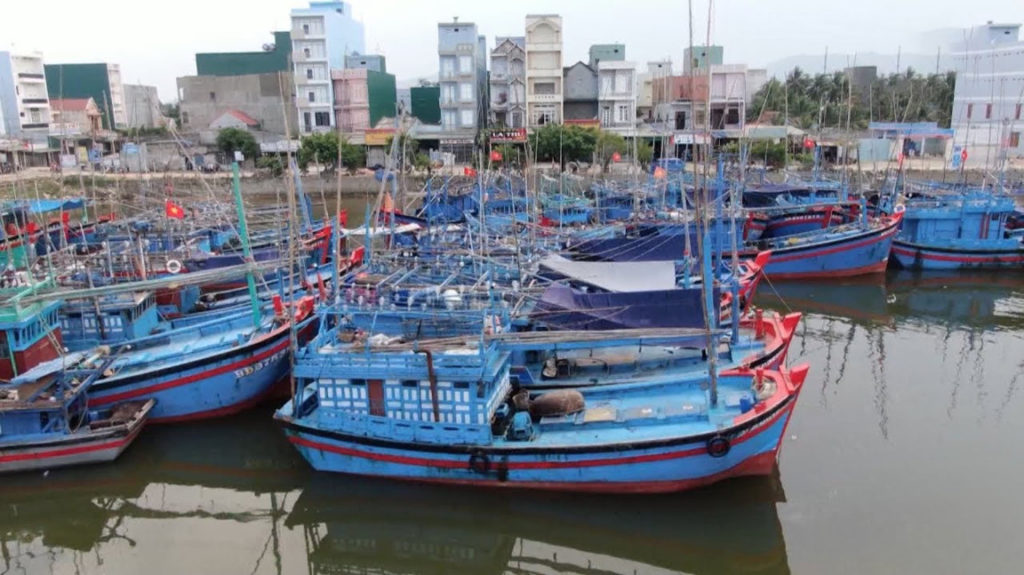
Boats docked at Tam Quan Hoai Nhon fishing port, Binh Dinh

At around 4.30 pm of October 27, the 97469 TS fishing boat of Mr. Vo Ngoc Doan (in Hoai Hai commune, Hai Nhon town, Binh Dinh) who is also its captain, with 14 employees, sunk while strived to seek for shelter to avoid the storm.

Before that, the 96388 TS fishing boat of Mr. Le Van’s (in Hai Thanh ward, Hai Nhon town) was on his way to Cam Ranh port (Khanh Hoa) to avoid storms, was destroyed and sank at 1 pm of the same day, 12 fishermen on this ship are missing.

In this very critical situation, there was no press mention of using helicopters to save lives. On October 26 at the online meeting directing storm response, Prime Minister Nguyen Xuan Phuc said he would mobilize helicopters to save lives, many domestic newspapers reported.

The Titanic Planet Facebook page, specializing in climate and weather research and forecasting, makes the following forecast:

The following is our forecasts in case the power and telecommunications cuts in Binh Dinh, Quang Ngai, Quang Nam, and Danang provinces.

From 1 am to 4 am of October 28, the torrential rain circulation of the super typhoon MOLAVE will hit Binh Dinh to Danang. After 4 am, the rain is probably calm, while in Quang Ngai, Quang Nam, Danang and Hue it will last until 10 am.

Hurricane winds will follow, around 3 am- 4 am will begin hitting the highest level, hissing until 10am. This is the most dangerous time. Flood water may rise after that, but the wind will knock and sweep away many green trees, corrugated iron roofs, tiles, and low houses.

The storm epicenter will go to Quang Ngai city around 6 am- 7 am.

It will be a really powerful storm

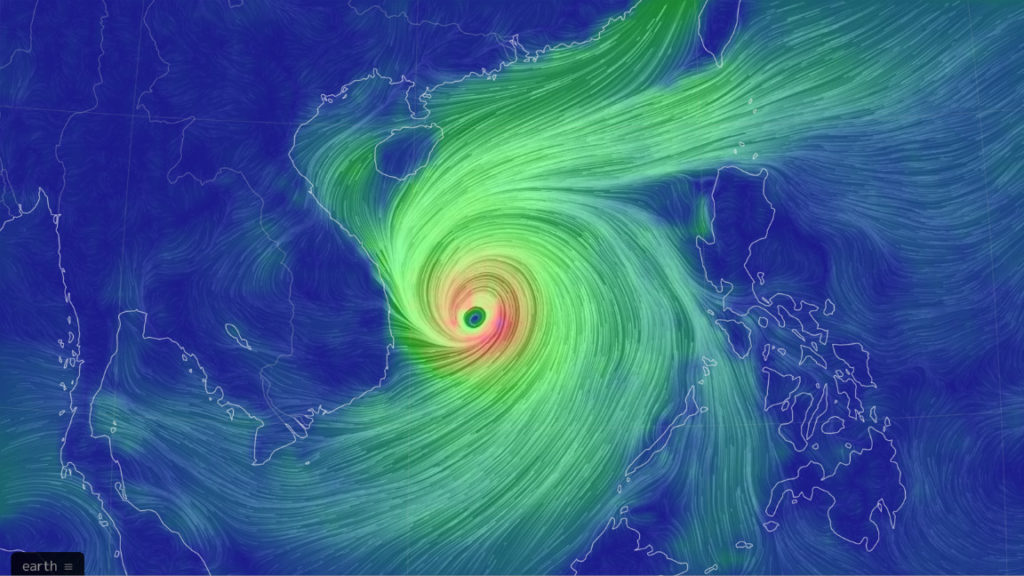
Super typhoon Molave- photo taken at 10 pm of October 27

At 4 pm of October 27, storms tend to speed up a little: travel speed 21-24km/h in the West – Northwest Northwest direction.

Based on aerial image from Japanese satellite Himawari-8, taken at 4 pm of October 27 (Vietnam time). The eye of the storm is far from Qui Nhon City 330km to the East, and from Quang Ngai city 391 km to the southeast.

Wind speed at the storm epicenter forecast at 185km/h

Forecast the destruction power of Molave storm: crazy, extremely dangerous

The storm is expected to go through Quang Ngai city

Expected time to occur: 5 am – 6 am of Oct 28

Extremely dangerous zones: Binh Dinh, Quang Ngai, Quang Nam, Danang

Forecast about wind speed and rain volume when Molave hits the central region

Area No. 1. The area where the storm’s center passes and the area 100km away from the storm epicenter:

– Including: Binh Dinh, Quang Ngai, Quang Nam.

– Expected time to be affected: from the evening of October 27 to noon on October 28

– Expected time of the storm’s landing: dawn on October 28

The direction of Molave ​​storm according to the forecast at 11 am on October 27 of the National Center for Hydrometeorological Forecasting

– Wind power: over 150km/h, 180km/h. Assessment of the impact of the wind: destructive winds, terrible destruction.

– Rainfall: heavy rains start in each batch, starting from the evening of October 27, continuous torrential rain from dawn to noon on October 28. Rainfall during the whole period: 800 mm-1m.

– Waves are over 10m high.

Area 2. The area to the North of the center of the storm makes landfall, more than 100 km from the storm epiccenter and the radius of 200km from the epicenter:

– Including: Danang and Hue.

– Expected time to be affected: from the evening of October 27 to noon on October 28.

– Wind power: 110-130 km/h. Assessment of the impact of wind: intense, very strong, can destroy rudimentary level 4 buildings.

– Rainfall: moderate to heavy rain in waves from the evening of October 27, torrential rain for 3-4 hours in the morning of October 28. Rainfall during the whole period: 400 mm-600 mm.

– Waves are over 7m high.

Area 3. The area to the south of the storm epicenter makes landfall, more than 100 km from the epicenter and the radius of 200 km from the storm epicenter:

– Including: Phu Yen and Nha Trang.

– Expected time to be affected: from the evening of October 27 to noon on October 28.

– Wind power: from 80-90km/h, may rise to 110km/h. Identify the impact of wind: storm winds, can blow up the big stump.

– Rainfall: moderate to heavy rain in waves from the evening of October 27, heavy rain within the first 1-2 hours of the morning on October 28. Rainfall during the whole period: 100 mm- 200 mm.

– Waves are high from 2-3 meters.

Area 4: The area to the west after the storm makes landfall 1-2 hours, on the way through the center of the storm when going inland:

– Including: Buon Ma Thuot, Pleiku, and Kon Tum.

– Expected time affected: early morning to late afternoon on October 28

– Wind power: from 80-90 km/h and may rise to 110km/h. Identify the impact of wind: storm winds, can blow up the big stump.

Vietnam coastal current, photo taken at 10 pm of October 28

– Rainfall: moderate to heavy rain in waves from the evening of October 27, torrential rain for 3-4 hours in the morning of October 28. Rainfall during the whole period: 400 mm-600 mm.

Area No. 1. The area to the North of the storm epicenter makes landfall, more than 200 km from the center of the storm and the radius of over 400 km from the epicenter

– Including: Quang Tri, Quang Binh, and Ha Tinh.

– Expected time affected: the morning of October 28 to the end of October 31

– Wind power: from 50-60 km/h. After the storm makes landfall in the southern part of Central Central, the northeast monsoon will be activated and continue to intensify here, strong seas.

– Rainfall: medium to heavy rain in waves. Heavy rains concentrated in the western regions of Ha Tinh provinces to Quang Binh from the evening of October 28 to the end of October 29.

– Waves are high from 2-3m.

Recommendation

– People in the No.1 areas should go immediately. This storm can be very devastating if you are located in the area of ​​the storm’s epicenter. People have 24 hours to prepare to evacuate if they feel they cannot cope with a storm.

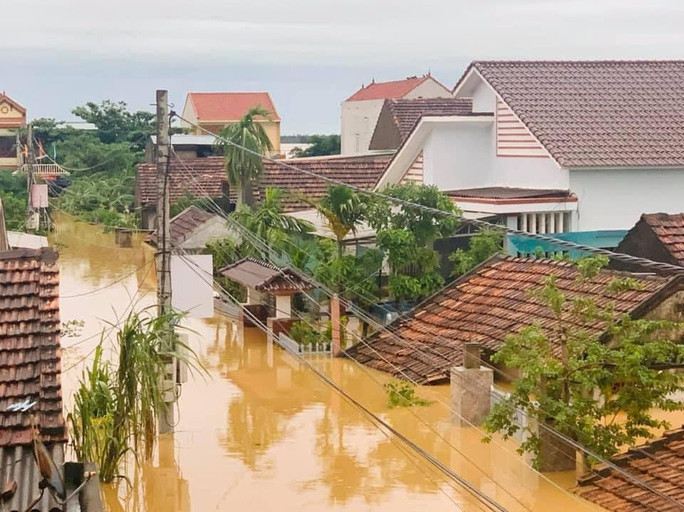
– When Molave storm come, tide levels are still high so areas No. 1, 2 and 3 will have flood as the water cannot go to the sea.

– Fishermen in the whole central region are not allowed to go to sea. From today, boats in the area from Quang Nam to Hue have to come ashore, anchored in an estuary or good wind/breakwater bay.

– Absolutely not stay on the fishing raft when the storm hits. Absolutely do not stay on cliffs, low-lying areas and coastal areas when storms land.

– For thick concrete houses with good foundations, use sand bags, water bags, large steel wire to ballast or tie corrugated iron or tiled roofs. Stick windows and doors with X-shaped tape for each frame. Seal any openings that are coming from your home. Absolutely closed when the storm’s mind hits and passes. Stay away from glass doors.

– Absolutely not stay in low houses, rudimentary, prefabricated houses. Evacuate to shelter with thick concrete walls, good foundations, and well-bred roofs.

– Evacuate and do not stay in low or low areas, where flash floods have occurred before. Bring furniture and valuables to the area as high as possible.

– Evacuate from the places prone to landslides.

– Due to heavy rainfall and fast floods, aquaculture farmers should be prepared for the risk that fish, shrimp, and aquatic animals will be shocked by the sudden drop in seawater salinity. The cage should be moved away from the shore, lower the cage further, and anchor the cage firmly. People should harvest agricultural products and seafood early before the storm comes.

– Hydropower plants from Quang Nam to Khanh Hoa should discharge less stored water in the reservoir to cut floods or reduce the severity of floods after the storm enters.

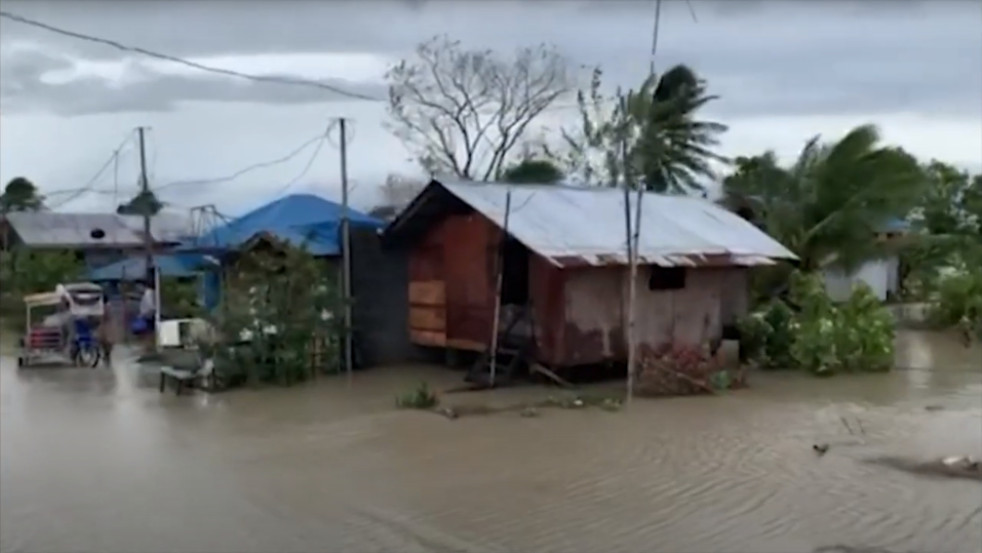
Tropical Molave Storms flooded Philippine streets

– Local authorities from Binh Dinh to Quang Nam need to prepare a detailed and professional rescue plan, as well as forecast possible risks to effectively rescue when something happens. This is a big storm, it’s not to be taken lightly.

– Urban areas should prune tree branches, lower billboards, clear drainage sewers to reduce damage caused by local inundation caused by heavy rains. Electric poles are also at risk of breaking, so a plan to cut off power is required for where the storm’s center goes.

– People within a radius of 100km from the epicenter of the storm that landed and passed through need: preparing necessities, food, drinking water, rechargeable batteries, mobile phones with radio stations (radio), warm clothes moisture-proof, boots, wall-breaking hammers (in case of getting stuck in rubble), basic medical equipment for accident prevention (cold medicine, bandage, disinfectant), list of local rescue hotlines/telephone numbers. The people in the storm epicenter passed and 100 km from the epicenter may have to undergo at least 3 days of isolation because of this storm.

Thoibao.de (Translated)

Recent public opinion flared with pity when people heard that Ho Duy Hai was thin, pale, and exhausted because he lost faith in the possibility that the National Assembly, the Procuracy, and the Supreme People’s Court would reconsider for him.

At the same time, Chief of the Supreme Justice Nguyen Hoa Binh reported to the National Assembly that: “No wrong conviction has been found yet“

Chief of Supreme Justice Nguyen Hoa Binh in the cassation trial of the death penalty sentence of Ho Duy Hai

“The trial of criminal cases in the past year has ensured the right person, right crime, right law, injustice, wrong, omitted crimes,” according to the report of the Supreme People’s Court sent to the National Assembly.

Hot news (not very happy) about death row inmate Ho Duy Hai was reported by FB Thang Soi:

On October 15, 2020, Ms. Nguyen Thi Loan had a visit to death row inmate Ho Duy Hai after four months. Hai as described by Mrs. Loan has never been so sick (thin). Hai is pale, thin, has a lot of hair loss, and still has a lot of white hairs even though he is only 35 years old.

Hai’s spirit is not good. Hai is depressed for being in prison for so long. Hai seems like he has lost all his hope, not willing to hear encouragement from his younger sister and  mother.

Last month meeting with his sister Hai was even more optimistic and healthy. After only a month, for unknown reasons, Hai became like that.

The atmosphere, the meeting space is no longer “easy to breathe” like the previous times.

Ms. Nguyen Thi Loan sadly confirmed the physical and mental exhaustion of Ho Duy Hai during her visit to her child on October 14, 2020.

The reason for mental exhaustion is that Ho Duy Hai did not see positive signals about his wrongful case would be resolved by the competent authorities. “They haven’t solved anything for me in the past ten years, they just do it their way,” Ho Duy Hai told his mother with utter frustration.

FB Khai Hoan commented:

“Thirteen years locked up in a dark room. Flattering, starvation, torture … there’s nothing to compensate for!”

Mrs. Nguyen Thi Loan, mother of death row inmate Ho Duy Hai

FB Tuyet Tuong wrote:

“I feel pity for Ms. Loan so much. Extreme suffering. Cry until the last tears. Please release HDH! ”

FB Chon Kim Bui said pessimistic:

“This case will be ignored, no one will solve it, although the people speak up a lot!”

A new news that is helping to brighten the details of the case, hopefully Ho Duy Hai, is the appearance of important witness Dinh Vu Thuong, whom the Procuracy said he  voluntarily recognized Ho Duy Hai although Thuong said completely differently.

However, with a blunt transparency to the end, Mr. Dinh Vu Thuong denounced the intentional borrowing of his name in order to add completely inaccurate statements to the records and indictments of the police investigation agency and the Long An province’s People’s Procuracy.

With this new fact, lawyer Tran Hong Phong and the family of defendant Ho Duy Hai recently continued to petition, at the same time denouncing the act of intentionally falsifying the case file and proposing a “re- appraisal.”

In this new application, lawyer Tran Hong Phong denounced by name investigator Le Thanh Trung, for the act of intentionally falsifying the above case file.

Attached to this application is witness Dinh Vu Thuong’s appeal. Mr. Thuong filed a complaint denouncing that his statements, as Mr. Thuong said, had been “added” and “his signature was faked.”

The content of the appeal also has other new details, is the confirmation of the character named Nguyen Mi Sol, known as the boyfriend of Hong, ơn of the two victims.

Witness Dinh Vu Thuong responded to the reporter about the whole incident at Cau Voi Post Office and confirmed that he completely did not identify Ho Duy Hai there, contrary to what was recorded in the indictment

Mr. Mi Sol confirmed that he was given testimony on January 14-15, 2008. But in the case file, only the testimony of this character was taken by the police in June 2008 (after arresting Ho Duy Hai).

The appeal was sent to President Nguyen Phu Trong, the National Assembly Standing Committee, the Judicial Committee of the National Assembly, the Supreme People’s Court; the Supreme People’s Procuracy; National Assembly deputies and press agencies.

Late afternoon of October 25, 2020 – Tuoi Tre Newspaper reports that the Judicial Committee of the National Assembly was reporting to the competent authorities on the Ho Duy Hai case!

The authorities here are: the Standing Committee of the National Assembly and the National Assembly!

Up to this point, Ho Duy Hai’s case has undergone two levels of trial: the first-instance and the appeal.

At the same time, this case has also undergone special proceedings: Cassation Review of the entire Judicial Council of the Supreme People’s Court – the highest and final level of trial in the Vietnamese judicial system!

Chief Justice Nguyen Hoa Binh and 17/17 judges of the Supreme People’s Court voted to pronounce the death penalty of Ho Duy Hai

Lawyer Dang Ba Ky gives the following possible scenarios:

“1. The first possibility: If requested by the Standing Committee of the National Assembly, the Chief Justice of the Supreme People’s Court shall report to the Council of Judges of the Supreme People’s Court to review the decision of the Council of Judges.

For states with a Constitutional Court, or an independent Tribunal, that may be different. But with the current legal regulations, if the situation arises, but the Council of Judges of the Supreme Court still defends its opinion, that is, it does not accept the request of the Standing Committee of the National Assembly, then theoretically that, the National Assembly will dismiss and remove from office all the current Judges, and then appoint a brand new panel to reconsider the case. But sure, that will never happen.

In the event that the Judicial Council of the Supreme Court accepts the request of the Standing Committee of the National Assembly, the Panel of Judges will remove the first instance judgment, cancel the Court of Appeal, cancel the Cassation Review and immediately declare Duy Hai is innocent or to re-investigate from the beginning!

The scene photo of the case file shows a series of locations where fingerprints were supposed to have but absolutely no fingerprints of Ho Duy Hai

2. Second possibility: If the Judicial Committee of the National Assembly, the Chief Procurator of the Supreme People’s Procuracy petition, the Chief Justice of the Supreme People’s Court requests, the Council of Judges of the Supreme People’s Court open a meeting to consider such recommendations and proposals.

Contrary to the first possibility, with this second possibility: the Supreme Court Council of Judges, is not required to open a session to review its own Judges decision but will go through two steps:

Step 1: The Council of Judges of the Supreme Court will open a session, to consider to see whether the proposal is reasonable, that is, there is a legal basis and any grounds. If the Panel of Judges thinks that there is no ground, it has the right not to open the reconsideration session.

Step 2: If the Judicial Council of the Supreme People’s Court unanimously reconsider its decision, the Judicial Council will open a meeting (Called the Second Session) to review the cassation’s decision as well as the case. This Step 2 has content exactly the same as Possibility 1 mentioned above.

In the case of the Council of Judges of the Supreme Court, accepting the request of the Standing Committee of the National Assembly, or accepting the proposals or recommendations of the Judiciary Committee, the President of the Supreme Court, the Chief Justice of the Supreme Court – then the Council of Judges will: Cancellation of the first instance, cancel the Appeal judgment, cancel the Cassation Review Decision, at the same time: Immediately declare Ho Duy Hai innocent or to investigate the case again from the beginning!

The statement of Mr. Phung Phung Hieu, who is the first witness, but 3 years later, the first testimony is given, but not by the police investigation but the Procuracy, after Ho Duy Hai being sentenced to death and verdict became effect 3 years earlier

II. Outstanding issues in laws and legal issues

In this case, “some senior officials” said that: Although the investigation of the Case had shortcomings, based on the “Reasonableness” of many other details such as: Why the perpetrator knows the location storing gold and the belongings at the scene …. So it is reasonable to confirm that Hai is guilty! However, in the same way, when in the opposite direction, you will find that: The unreasonable details that can be used to prove that Hai is guilty, is much more than that:

   1. In many times they all said before the case: Ho Duy Hai and the victims were chating and flirting, caressing each other – But the police did not find any fingerprints ?? !!

   2. The killer killed two girls with a knife, cutting board, not a professional killer, also struggled with the victims, but there was no fingerprints at all ?? !!

   3. The perpetrator claimed, after killing the victims, he came to wash his hands, clean the faucet, and strangely enough, he did not leave any fingerprints ?? !!

   4. The time of the victim’s death, which is not clearly confirmed, leads to the misidentification of alibi of other suspects?? !!!

   5. The culprit of the crime is the knife, cutting board ….. the tools can be used for identification of the perpetrator had been disappeared from the human world, not a bit of ruins? ?? !!!

In a case with so many irrationalities – The question is: Why not let the case be investigated and tried again from the beginning ?! Just cancel the sentence to re-investigate without declaring Hai’s innocence! So why, not let the case have a chance to turn around once, to review, resolve, and reassess the whole. By then, no matter what the outcome may be when everything is clear, everyone must be in awe! And also no one to torment or blame each other ?! Why they do not give such an opportunity ?!” lawyer Dang Ba Ky stated his opinion.

Thoibao.de (Translated)
There is much analysis that natural disasters in Vietnam in recent years have been increasingly exacerbated by deforestation and hydroelectricity. Is this the main cause?

According to Vu Thanh Ca, a lecturer of the Faculty of Environment, Hanoi University of Natural Resources and Environment, a report by the European Working Group on Dams and Floods, published in 2010, shows dams (for hydroelectricity, irrigation, and water supply) “has helped with flood mitigation in all European countries.”

However, the degree of flood mitigation depends on reservoir capacity and operation of the lake. Large lakes, which are well forecasted to be able to release water before flooding will greatly reduce downstream flooding, while smaller lakes will have little capacity to reduce flooding.

Hydropower helps reduce floods or creates more floods?

Vietnam has many hydropower reservoirs built in recent years. The Government also has many relevant legal documents, specifying standards for reservoir construction and operation, especially in case of floods. Accordingly, the investor must submit the project design to the competent state agency for approval and implementation.

Particularly in Thua Thien Hue, where a serious landslide occurred in Rao Trang Hydropower Plant killed 13 soldiers, it is estimated that the three main rivers here are carrying 13 hydroelectricity projects.

To make these hydroelectric power plants, many thousands of hectares of protective forests have been destroyed for lake construction. Many hills and mountains were flattened to serve as stations, roads and related management works.

Deforestation makes flooding more serious in Vietnam

Mr. Nguyen Thanh Ca said that hydropower reservoirs in Vietnam are operated according to international standards. And although the flood discharge procedure is different, the main point is that the lake has two main thresholds: Storing water and discharging water.

Depending on the amount of rain, the lake discharges water according to which flow. When heavy rain lasts for a long time, the lake discharges water with a flow equal to the water flow to the lake. That is, at that time, the amount of water flowing downstream does not change compared with when there is no lake.

In other words, this means “it’s not hydroelectric that causes floods.” There are many studies showing that without hydropower, floods would be much higher. Because the hydroelectric lake has received a considerable amount of water instead of all that water flowing downstream.

However, Mr. Ca admits that hydropower reservoirs cause numerous negative impacts on the environment and ecology, increasing coastal erosion, and causing flash floods if the dam is broken. The construction of reservoirs together with the construction of associated infrastructure requires the leveling of hills and mountains, deforestation, which in turn increases floods. Therefore, Mr. Ca said he does not support hydroelectricity.

Forests were cut down

While storms and floods are still raging in the Central region, users of social networks transmit Google Maps satellite photos showing that Vietnam is almost no forest. Only a ‘creepy’ gray remains in the Indochina junction bordering Laos and Cambodia.

According to statistics from the Ministry of Agriculture and Rural Development, deforestation in Vietnam is still progressing seriously despite many reports from the Vietnamese government showing efforts to restore forests.

Between 2010 and 2015, 300,000 hectares of forests were cut down in Vietnam – roughly four times the size of New York City.

And in 2018 alone, 10,000 ha of Vietnam’s forests disappeared.

Huy Nguyen, a research fellow on Natural Disaster Management and Climate Change Adaptation at Kyoto University, published on Facebook the satellite photos showing the lost forest area in Vietnam over the past 20 years.

According to Mr. Huy Nguyen, when analyzing the satellite maps which have been continuously taken from 2000 up to now and using the method of splitting image layers, running time-lapse, “it is shocked with the lost forest area.”

“The fact that we have lost a very important layer of the tree is the primeval forests east of the Annamite, the West Truong Son, the Central Highlands region, and even the part of the forest in Laos and Cambodia that are very important in regulating the climate of Vietnam.”

“The lost primary forests (areas shown in red in the maps) have been replaced by industrial crops (rubber, coffee, pepper, cashew, banana, and especially acacia for timber) has turned mixed forests into species monoculture forests. These forests have no nature for keeping water and regulating the climate. They just consume water and consume a lot of water.”

“They take underground water, or permanently lose groundwater because people have to drill wells to get water to irrigate them. The increase in the area of ​​production forests, the area of ​​industrial crops has pushed Vietnam into the situation of current and future water crisis.”

As a result, the climate heats up, and will get even hotter. Because there is no tree layer, the southwest wind easily crosses the Truong Son mountain range into Vietnam, causing prolonged heat and drought, especially in the Central region.

But in the rainy season, there is a risk of flooding more and more serious due to the loss of primary forests, unable to retain water anymore, Mr. Huy Nguyen analyzed.

Thoibao.de (Translated)

Source: https://www.bbc.com/vietnamese/vietnam-54626203

Facebook status of activist Trinh Ba Tu with a call for help that his information from December 31, 2019, to February 9, 2020, about the Ministry of Public Security’s attack Vietnam to Dong Tam village has been hidden by Facebook from the personal page without any notice

The Los Angeles Times on October 22 published an article by two authors David S. Cloud and Shashank Bengali with the title “Facebook routs free speech. But in Vietnam, it is adding censorship.”

The article mentions that Facebook and its founder Mark Zuckerberg speak of the defense of freedom of expression with the exception in specific cases, such as when inciting violence. However, in countries including Cuba, India, Israel, Morocco, Pakistan, and Turkey, Facebook often restricts posts that those governments consider to be sensitive or out of line. This situation is shown most clearly and honestly in Vietnam.

Facebook was switched to the local language for Vietnamese users in 2008 and more than half of the people nationwide have accounts in this social network. Facebook helps government critics and pro-democracy activists in both Vietnam and the United States overcome the communist system’s tight control over the media.

However, according to The Los Angeles Times, in recent years, Facebook has repeatedly censored posts by dissidents in Vietnam with the purpose to try to appease the Government of Hanoi when Vietnamese leaders threaten to close Facebook if they do not comply.

Instead of using its leverage as Vietnam’s largest media platform to fight censorship, Facebook has become an accomplice in the government’s increased repression of voices supporting democracy.

Speaking more clearly about the situation mentioned above, from Hanoi, independent journalist Nguyen Vu Binh, who used to work at the Communist Magazine, said:

“This is a very serious problem because a lot of people have been blocked from Facebook, from commenting, a lot of problems Facebook causes to Vietnamese users when they post or comment that the local authority presumes to affect the order’s security. A lot of people are annoyed but unable to do it because they (Facebook) say their censor is based on is unclear community standards. Many people are prohibited, locked accounts, not allowed (content) to appear on Facebook in Vietnam, but only for present abroad. There are many ways to prevent the freedom of information on Facebook and many people are very frustrated.”

Specifically, Facebook said it often limits posts and users for one of two reasons including violating the “community standards” that the company says applies to users around the world, and local law. The posts in the second category are blocked in the country where they are found to be illegal, but still accessible elsewhere.

Confirming the above fact, Mr. Nguyen Van Hai, also known as blogger Dieu Cay, told RFA by phone as follows:

“The situation on Facebook in Vietnam is that the majority of democracy activists who report on serious human rights violations often got blocked. Even before a big incident happened, the authorities prepare from the public opinion to all the anti-cyber forces to guide the public opinion, and at the same time, they tried to report all ways to block information, like the Dong Tam case. the most outstanding case. Immediately after the Dong Tam incident, all the activist spoke on the Internet, the authorities even had a media campaign to attack them. Dong Tam is one of the most prominent cases in which they have the biggest attack campaign on the Internet ever. Personally, about 6 articles related to Dong Tam have been deleted, Facebook warned that they can permanently close their page.”

The article published on the Los Angeles Times quoted Facebook as saying that in some cases, the Vietnamese government forced users to disable their own accounts that were not related to the company.

In addition, Facebook also said in a statement: “We do not always keep an eye on governments in the countries where we operate, including Vietnam.”

According to the Los Angeles Times, with a young population and one of the fastest growing economies in Asia before the COVID-19 pandemic, Vietnam was the main growth market for Facebook. The conglomerate controls more than 40% of Vietnam’s $760 million digital advertising market despite having no offices or full-time employees in the country.

The author of the article published on October 22 by the Los Angeles Times quoted Mr. Dipayan Ghosh, a former policy advisor at Facebook who co-directed the Digital Platforms & Democracy Project at Harvard’s Kennedy School as after:

Mark Zuckerberg apologized to the US congressmen for leaking the personal data of millions of Facebook users.

“I think for Zuckerberg the calculus with Vietnam is clear: It’s to maintain service in a country that has a huge population and in which Facebook dominates the consumer Internet market, or else a competitor may step in. The thought process for the company is not about maintaining service for free speech. It’s about maintaining service for the revenue.”

Sharing the same point of view, blogger Dieu Cay said:

“They see the market like that so it seems to obey by the requests of the Hanoi government. People in Vietnam have no choice but to use social media to raise their voices because the entire press is in the government’s hands.”

Ho Chi Minh City’s Public Security Newspaper Network on October 8 quoted Vietnam’s Minister of Information and Communications Nguyen Manh Hung said that Facebook had blocked political ads from fan pages, accounts of “reactionary and terrorist organizations.”

According to the minister, Facebook removed 286 accounts that were alleged to be fake in 2020. Of these, 50 were said to be fake leaders of the Party and State of Vietnam.

In addition, data from the ministry shows that in 2020 alone, Facebook removed more than 2,000 articles that allegedly made hate speech, defamed party leaders, the State, brands, individuals, organizations, increased 500% compared to the whole year 2019, the blocking rate will reach 95%.

Facing this blocking situation, many Vietnamese Facebookers have turned to other forums to transmit information but have not brought about positive results, as journalist Nguyen Vu Binh:

“Before there was a period when Facebook blocked and banned like that, there were Minds, people switched to it relatively in a short time. This network is poorly interacting, not like Facebook. At first, it was currently switched to the Facebook side by both sides, but later on, Facebook cut it off, not allowing the connection. People found it (Minds) was also problematic, unlike Facebook, so they went back to Facebook. Currently, for Vietnam, Facebook is still the largest, most vibrant, and effective forum so people mainly use Facebook, while Twitter uses English, and other networks are rarely used. So when being banned, people are very upset but there is no network or no way to replace or handle this.”

In an email responding to a previous RFA question, Amy Leferve, Facebook’s Communication Policy Manager, said that although Facebook does not agree with the laws that the Hanoi Government has put forward, if the group continues to reject the the Government of Hanoi’s legal requirements block access to content in Vietnam, most likely Facebook platforms will be completely blocked. This result will cause even more information restriction because then all voices in Vietnam will be silenced.

The fact that activists still has to use Facebook as the only solution today, despite its limitations in many aspects, brings many difficulties for social activists, democracy and human rights activists in the S-shaped country. according to blogger Dieu Cay:

“In Vietnam, the activists in the country still have to find ways to fight, like Vo Hong Ly now has 3 pages, one page after equipment and another. There are proposals to the agencies of the Government or Congress, Facebook must also hear but in the end the right to do business in their hands. “

According to information provided by Amy Sawitta Lefevre in an email to RFA, Facebook always seeks to respect the law in all countries where this social network operates, but always does everything in its power to strictly protect the basic rights of all internet users, including freedom of speech.

However, many Vietnamese users said that the above-mentioned content is just theoretical because, in reality, things are going the opposite direction!

Thoibao.de (Translated)

Source: https://www.rfa.org/vietnamese/in_depth/fb-highly-offers-free-speech-but-supports-censorship-in-vietnam-10232020152808.html

Social activist-blogger Nguyen Lan Thang on a trip to help flood victims in Quang Binh, October 2020.

In the context of serious flooding in the Central region, on October 21, Prime Minister Nguyen Xuan Phuc issued a letter demanding “reorganization of campaign activities, voluntary donations to support people in affected areas. natural disaster.”

Accordingly, in order to mobilize donations and support in accordance with regulations and practicality, PM Phuc requested the Central Committee of the Vietnam Red Cross Association and ministries, branches, and localities to organize and supervise the work of mobilization donations to support.

Meanwhile, recently Deputy Minister of Defense-Senior Lieutenant General Le Chiem admitted that there is a situation of grassroots cadres sharing the hardtack for relief of the Ministry of Defense as gifts. This information is of particular interest to the community. However, on the afternoon of October 23, talking to the local media on the corridor of the National Assembly, Gen. Le Chiem explained that what he said had happened years ago and he raised it to alert authorities in localities.

Gen. Le Chiem added that according to his record, the rainy season in 2020 has not discovered a phenomenon of corruption of relief goods. At the same time, he emphasized that local leaders have a responsibility to prevent this situation so that relief goods can reach people in the flooded area.

Ms. Nguyen Thi Ba, a resident of Saigon, shared with RFA about such information that she had heard over the past few days. Ms. Ba said that no matter what instructions, requests, or explanations from the government representatives but “Actually this is not the first time, but there have been many evils at all levels of government, functional organizations abused relief money for their spending at 5-star hotels and eating in high-class restaurants. As a result, trust cannot be created one day, it takes time and manifests itself through actions. Why can singer Thuy Tien be able to call for such money? Central Vietnam is not the first time flooded by storms and floods like in 2020, but for many years, it has been the same every year, just a little or a lot. Why is there no organization or agency to call for such a large amount of support? So the authorities have to review themselves again.”

Spontaneous relief ineffective?

From Nha Trang, journalist Vo Van Tao told RFA that it is reasonable that people do not have faith in the rescue work and relief work of the authorities.

“Although the Prime Minister said that, but surely in the real situation, people in the Central are suffering. Only yesterday, the Minister of National Defense pledged to give relief helicopters, while the people died for half a month. Very sloppy. So if this regime remains, the people will all die.”

Journalist Vo Van Tao mentioned Decree 64 that “apart from organizations and units such as the Fatherland Front and the Red Cross, no organization, unit or individual is entitled to receive relief donation.” However, with the spirit of the mutual love of the Vietnamese people and in the current state of the danger of flooding in the Central region, the fact that people everywhere proactively rescuing their fellow citizens is necessary and they should not worry when Decree 64 is violated the Civil Code.

“My son-in-law is in Ninh Hoa town, 30 kilometers north of Nha Trang, just recently told me that there is a campaign people cook rice cakes to donate for flood-affected people. In Ninh Hoa, they claim that anyone who needs to deliver relief goods to Central Vietnam is ready to help.”

An old woman in a flood area in Quang Binh.

But the VTV news about the flood relief report of VTV Radio, done by reporter Lien Lien and broadcast on October 20, causing frustration in public opinion. Reporter Lien Lien reported that the relief work of volunteer groups was not only ineffective but also affected the relief work of the local government.

Social activist-blogger Nguyen Lan Thang, who is present in Quang Binh to provide relief to local people there, on the evening of October 23, presented the practical situation that he witnessed with his own eyes, gave his opinion on VTV’s newsletter:

“I must say that volunteering in the past is inherently very difficult. The overall coordination of the work during this disaster requires a lot of experience, resources as well as manpower. In Vietnam up to now, people also have no experience in providing aid. But because people love each other, people have to find ways to mobilize and find ways to save themselves and help each other. Of course, there is a lack of experience, lack of equipment, and resources, making it unprofessional to save each other. But I say one thing is that the VTV newsletter is very wrong when it comes to the fact that the people carrying out such relief work affects the local rescue work. I think it is completely inappropriate for VTV to use those words. ”

Mr. Nguyen Lan Thang repeated again and again about fishermen in Quang Binh who were fasting, starving for 3-4 days and nights and doing everything possible to save the people trapped in the vast water field, flooding the roofs. .

“In that context, when fishermen come to save other lives, they must say that saving lives means that people are very wonderful.”

Journalist Vo Van Tao commented on VTV’s news:

“The speech of reporter Lien Lien is actually a scandal causing frustration in society, especially those with a heart in Vietnam. This woman is the result of the propaganda of the state. For her, all things that come from the state are true.”

Journalist Vo Van Tao stated his opinion:

“I think every time a natural disaster is like that, in such large areas, no state agency can take care of it at all; Even spontaneous individuals like Thuy Tien or other famous celebrities work together, it can’t be helped. In my opinion, it is a good force to add a force that is good. And, state administrative agencies must find ways to create conditions to support spontaneous people to be most effective and safest.”

Gen. Le Chiem, when talking to the press on October 23, also suggested that those who went to the rescue want to bring the goods directly to the people, so the local government had to organize navigating, transporting goods to help get into the area in need.

Gen. Le Chiem received news that the provinces including Thua Thien-Hue, Quang Tri, Quang Binh, Ha Tinh, Nghe An, Thanh Hoa all suffer from the situation that people have not been able to access the aid, but the cargo traffic congestion on the road again a lot.

On the same day October 23, the President of the Vietnam Red Cross Association, Ms. Nguyen Thi Xuan Thu, told domestic media that Decree 64 is intended for organizations assigned by the state to perform humanitarian tasks. This is a form of State management with organizations with assigned tasks such as the National Front, the Vietnam Red Cross, social and charity funds, not applicable to individuals. However, Ms. Nguyen Thi Xuan Thu noted that Decree 64 still has one point that encourages individuals to participate in voluntary work. If they comply with the provisions of the law, do nothing wrong, and the state must encourage and honor them. At the same time, she said that this decree was issued for a long time in 2008 and it is necessary to amend it and supplement a number of articles.

Radio RFA spoke to a number of people across the provinces / cities in Vietnam, and heard that most of them have the same point of view as Ms. Nguyen Thi Ba that:

“If I am a person with money and kindness, I just invite my friends to do it, but I do not send it to state agencies. Believe it or not, and trust is long gone. “

Economist Nguyen Huy Vu shared on his personal Facebook page that people do not believe the government manages money to donate to relief out of fear of corruption and if only those who raise money go to distribute. Charity goods are facing a lot of difficulties. Therefore, Dr. Nguyen Huy Vu said that if there is a need for close and quick coordination between the local government and mass organizations and individuals who volunteer, people will surely receive effective and meaningful help.

Thoibao.de (Translated)

Source: https://www.rfa.org/vietnamese/in_depth/people-actively-to-help-flood-victims-in-central-of-vn-despite-decree-64-10232020174256.html

Vietnam riot police

Leaders of the Dak Lak province’s Party Committee said up to this point they had all the conclusions showing Mr. Bui Van Cuong, the Secretary of the province’s Party Committee, has not plagiarized his doctoral thesis.

Mr. Bui Van Cuong himself, after being re-elected secretary of Dak Lak province’s Party Committee for the 2020-2025 period, also affirmed that he was not plagiarist.

Mr. Pham Minh Tan, standing deputy secretary of the Dak Lak province’s Party Committee quoted the conclusion of the Sub-committee for the Protection of Internal Politics on the results of the settlement of the denunciation against Mr. Bui Van Cuong:

“Verification results up to the present time show that comrade Bui Van Cuong has no plagiarism behavior, did not seriously violate the regulations of the Ministry of Education and Training in his doctoral research at the Marine University in 2018 as the denunciation content stated in the appeal dated February 10 of Mr. Hoang Minh Tuan.

“Comrade Bui Van Cuong has not used an illegal doctorate degree nor violate the Politburo’s regulation No. 126 dated February 28, 2018, on some issues of political protection within the Party.”

Accordingly, the Sub-committee for Internal Political Protection concludes that Mr. Bui Van Cuong “has no act of plagiarism” after many months of consideration.

Smeared before the Party Congress?

The press quoted Mr. Bui Van Cuong as saying that there was a “media campaign” to defame him on the eve of the Party’s National Congress.

According to Mr. Cuong, the distortion campaign against him was very methodical. Initially, this group blogged, sent emails to spread defamatory information, then hired “some guys” to stand in the name of the denunciation; asked some newspapers and  magazines to write articles and finally hired KOLs (Facebookers with many followers) on social networks to make “dirty news storm.”

Mr. Cuong also affirmed that many newspapers and radio stations did not file denunciations because they contacted the province’s leadership and viewed the results of the Ministry of Education and Training and Maritime University, checked the contents of the denunciations and understood them as false crazy, and fake. “Except for the Environment and Society Journal which intentionally do not verify information,” Cuong said.

The article on Environment and Society Journal published an article about Mr. Bui Van Cuong

On the morning of September 30, the Environment and Society Journal was also sanctioned by the Press Department for incorrect information about the Secretary of the Dak Lak province’s Party Committee.

According to this decision, the Environment and Society Journal was fined VND50 million and suspended for two months.

Around the end of August 2020, the journal published the article “Secretary of the Party Committee of Dak Lak is accused of plagiarism and scholarly fraud?” believed to be of Dr. Pham Dinh Quy.

The article documented the doctoral thesis denunciation of Mr. Bui Van Cuong of having three theoretical research chapters that have copied about 70% of the previously published works.

This article shows evidence that Mr. Cuong has also copied from other publications but did not cite the source and cite false documents.

Mr. Quy thinks that this is an academic lie, according to the regulations on doctoral training of the Vietnam Maritime University, Mr. Cuong is not eligible to defend his thesis. However, Mr. Cuong was still granted a doctorate.

The BBC also noted that after the Dak Lak police conducted urgent arrests of denunciators, Mr. Bui Van Cuong’s doctoral thesis had disappeared on the website of Vietnam Maritime University.

Journalist Hoang Manh Ha, former secretary of the Ho Chi Minh City Law Journal, wrote on Facebook: “The Institute’s website has a section to store PDFs of master’s and doctoral theses since 2017. Mr. Bui Van Cuong defended his doctorate at this school in 2018, but people could not find his thesis. It proves that it has just been deleted when public opinion is noisy around the keyword ship propeller.”

Subsequently, this thesis came back on the website of the Maritime University after a few days.

Dak Lak police arrested two people involved

On the afternoon of September 30, Dak Lak province police announced the urgent arrests Mr. Pham Dinh Quy – lecturer at Ton Duc Thang University (Ho Chi Minh City) – about slander according to Article 156 of the Criminal Code.

Previously, on September 21, Dak Lak police arrested Dr. Hoang Minh Tuan (born 1980, a student of Dr. Quy), who filed a complaint against Mr. Cuong’s “plagiarism” while this person was on his way from the residence in Cu Kuin district moved down to Khanh Hoa.

As the BBC reported, on September 23, Dr. Pham Dinh Quy and his wife were suddenly surrounded by eight police in plain clothes. After that, the police asked Mr. Quy to take them to his home for search. Next, Mr. Quy was taken to the Ho Chi Minh City Police Department to work, and later the policemen took him to Dak Lak.

Mr. Pham Dinh Quy (left) has won many martial arts awards at all levels

At the time of the incident, Mr. Quy’s family assumed that this was an abduction because the family did not receive any notice.

Master Pham Dinh Trang told the BBC on September 30:

“Up to 11 am of September 30, 2020, I have just received a notice from the police of Dak Lak province. In those two notices, the notice slip of the Dak Lak post office on September 27, 2020.”

According to Mr. Trang, it was nine days since his son was “invited to work” he had received any notice.

Thoibao.de (Translated)

Source: https://www.bbc.com/vietnamese/54565142