
Vì sao việc sáp nhập hệ thống hành chính của T. Lâm bị “phanh” trước HNTW15?
Chủ trương tinh gọn bộ máy hành chính, một phần quan trọng trong chương trình cải cách thể chế của Tổng Bí thư Tô Lâm, đang đối mặt với những trở ngại lớn về pháp lý và sự đồng thuận từ cấp cơ sở.
Đặc biệt là trước đề xuất mới, yêu cầu trên 50% hộ dân tán thành thì các địa phương mới tiếp tục lập đề án sáp nhập, chia tách, đổi tên đơn vị hành chính.
Theo giới quan sát, động thái này được xem là một dấu hiệu rõ ràng cho thấy chủ trương sáp nhập các tỉnh, các xã dường như đang bị “chặn lại”, hoặc ít nhất là bị trì hoãn một cách đáng kể trước HNTW 15.
Những thách thức này không chỉ đến từ sự phản đối tự nhiên của người dân khi phải thay đổi danh giới hành chính, mà còn được phản ánh qua những vấn đề bất đồng trong nội bộ của đảng.
Điển hình là vụ việc ở ngõ Thông Phong, phường Văn Miếu (Hà Nội), nơi Tổ dân phố tự ý treo thông báo sẽ tiến hành “bắt giữ người vi phạm” vì hành vi… vứt rác.
Sự việc này, theo giới phân tích, là hệ quả của việc bộ máy hành chính cơ sở bị thu hẹp mạnh sau các đợt sáp nhập.
Theo các chuyên gia luật nhận định, việc người dân địa phương tự ra luật để quản lý dân cư là dấu hiệu của sự lỏng lẻo trong cơ chế giám sát và thực thi pháp luật ở cấp thấp nhất.
Khi chính quyền cấp cơ sở phải quản lý quá nhiều khu dân cư với nhân sự hạn chế, đã dẫn đến tình trạng “phép vua thua lệ làng” , nơi người dân phải tự xử lý thay cho cơ quan chức năng của nhà nước.
Hành vi tự ý kêu gọi người dân bắt giữ người vi phạm là vi phạm Điều 157 Bộ luật Hình sự , làm dấy lên lo ngại về tình trạng tự hành xử trong các khu dân cư.
Điều đó đã khiến giới quan sát đặt câu hỏi: Phải chăng đây là giải pháp “phanh đột ngột” chủ trương sáp nhập và cho thấy sự thất bại của chủ trương tinh gọn bộ máy của Tổng Bí thư Tô Lâm trước HNTW15?
Hồng Lĩnh – Thoibao.de
TRẦN CẨM TÚ “RA ĐÒN”: TÍN HIỆU CẢNH BÁO GỬI ĐẾN TÔ LÂM
Ngày 7/11, Thường trực Ban Bí thư Trần Cẩm Tú đã ký ban hành Kết luận số 205 của Bộ Chính trị, trong đó có đoạn nhấn mạnh: “Xử lý nghiêm việc lợi dụng cơ chế đặc biệt để bố trí, sắp xếp cán bộ không đúng đối tượng, không bảo đảm tiêu chuẩn, điều kiện vào vị trí lãnh đạo.”
Nghe qua tưởng là lời nhắc chống tiêu cực chung chung, nhưng nếu đặt vào bối cảnh đấu đá quyền lực hiện nay, phát biểu này giống như một mũi tên bắn thẳng vào phe Tô Lâm – người đang kiểm soát khối công an và nắm trong tay mạng lưới thân tín trải khắp Trung ương.
Từ lâu, trong giới chính trị đã râm ran về “cơ chế đặc biệt” mà Bộ Công an tận dụng để thăng tiến thần tốc cho các tướng lĩnh thân cận. Nếu phải nêu ví dụ, không ai tiêu biểu hơn Lương Tam Quang và Nguyễn Duy Ngọc – hai “đệ ruột” của Tô Lâm.
Lương Tam Quang từ Thứ trưởng nhảy thẳng lên Bộ trưởng, rồi chỉ sau hai tháng đã vào Bộ Chính trị – tốc độ chưa từng có tiền lệ.
Nguyễn Duy Ngọc cũng đi con đường tương tự: thăng chức liên tục, nắm các vị trí trọng yếu trong Bộ, rồi được “đặc cách” đưa lên Ban Bí thư, dù tuổi đời và thâm niên đều chưa đủ chuẩn.
Trong khi đó, Trần Cẩm Tú – người đứng đầu Ủy ban Kiểm tra Trung ương, vốn nổi tiếng là “người cầm roi của Đảng” – hiểu rất rõ từng kẽ hở trong công tác cán bộ. Việc ông Tú chọn thời điểm này để nhấn mạnh cụm từ “lợi dụng cơ chế đặc biệt” không thể là ngẫu nhiên.
Đặc biệt khi trước đó, Tô Lâm liên tục “cắm cờ” phe mình: đưa hàng loạt người Hưng Yên vào vị trí chiến lược, từ trung ương đến địa phương; con trai ông, Tô Long, cũng vừa được nâng lên Cục trưởng Cục An ninh mạng – một vị trí cực kỳ nhạy cảm.
Thông điệp mà Trần Cẩm Tú gửi ra rất rõ ràng: “Ủy ban Kiểm tra sẽ không còn im lặng.”
Nếu Bộ Công an tiếp tục mở rộng quyền lực và lạm dụng cơ chế đặc cách, thì đòn kiểm tra – kỷ luật có thể được kích hoạt bất cứ lúc nào.
Nói cách khác, đây là lời cảnh cáo chính trị tinh tế, nhưng đủ sức làm rung chuyển thế cờ quyền lực trước thềm Đại hội XIV.
Ánh Nguyên – Thoibao.de
Khi hình ảnh của T. Lâm bị hoen ố bởi sự xa hoa không nằm ở chiếc đồng hồ bạc tỷ?
Trong bối cảnh Hội nghị Trung ương 15 đang đến gần, trên mạng xã hội đã xuất hiện nhiều thông tin được cho là “bất lợi” liên quan đến cuộc sống xa hoa của Tổng Bí thư Tô Lâm và phu nhân – là bà Ngô Phương Ly.
Theo giới quan sát, sự chú ý của công chúng, đã chuyển hướng từ những vụ án kinh tế lớn sang những chi tiết tưởng chừng như nhỏ nhặt, nhưng lại mang ý nghĩa biểu tượng sâu sắc: tài sản cá nhân và lối sống của các quan chức cấp cao.
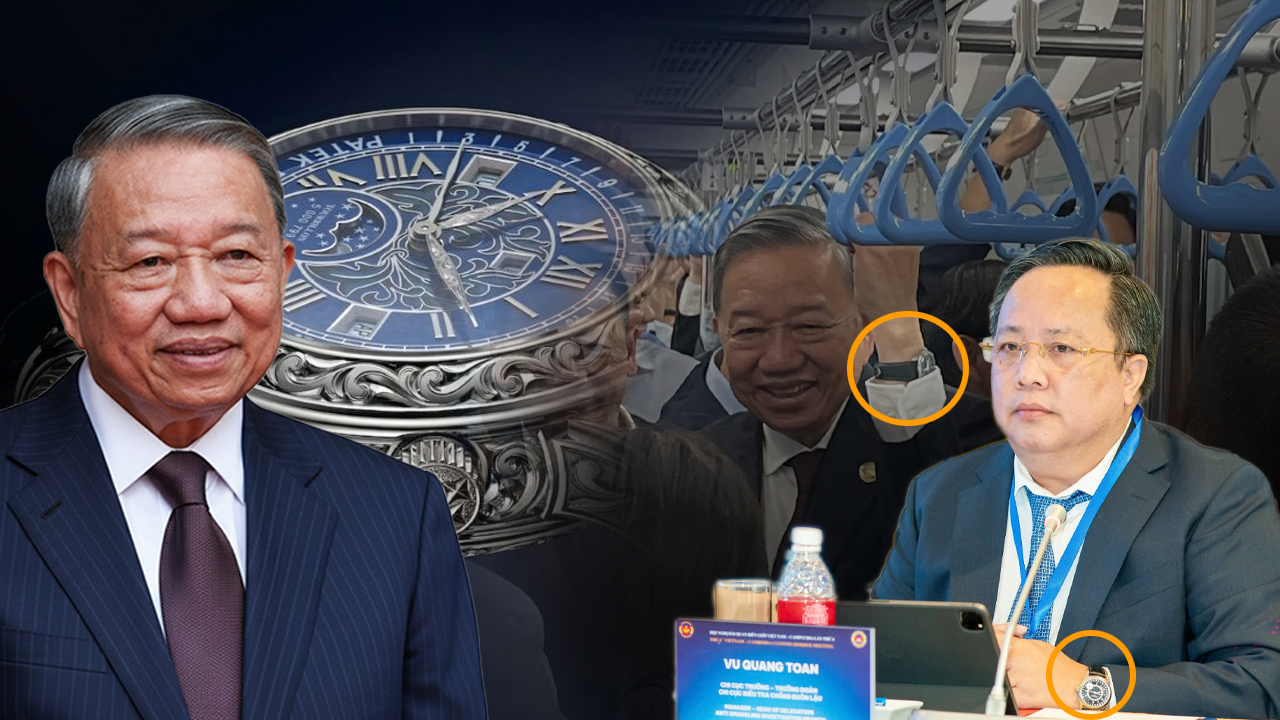
Gần đây, hình ảnh Tổng Bí thư Tô Lâm đeo một chiếc đồng hồ được cho là Patek Philippe với giá trị nhiều tỷ đồng trong chuyến đi thử metro Bến Thành – Suối Tiên ở TP. HCM đầu năm 2025.
Cùng với thông tin về người đồng hương Hưng Yên – ông Vũ Quang Toàn, Cục trưởng Cục Điều tra chống buôn lậu, Tổng cục Hải quan, cũng bị phát hiện đeo một chiếc đồng hồ xa xỉ tương tự.
Điều đó, đã châm ngòi cho một cuộc tranh luận gay gắt về đạo đức công vụ, và sự minh bạch trong tầng lớp lãnh đạo, cũng như giới công chức nhà nước ở Việt nam đã hoàn toàn đi ngược với chủ trương tiết kiệm.
Điều đáng nói, những sự kiện vừa kể lại được truyền thông đăng tải rộng rãi, là một nỗ lực của truyền thông Nhà nước nhằm xây dựng hình ảnh người đứng đầu “gần dân”, nhằm thu hẹp khoảng cách giữa chính quyền và nhân dân.
Tuy nhiên, hiệu ứng truyền thông này đã phản tác dụng nghiêm trọng khi ống kính đã vô tình phơi bày chiếc đồng hồ trên cổ tay của các lãnh đạo, được đồn đoán là có giá trị lên tới nhiều tỷ đồng.
Đây là một tài sản có giá trị bằng cả một căn nhà mà nhiều người dân Việt Nam phải làm việc hết sức vất vả, và phải “bóp mồm, bóp miệng” cả đời mới có thể mua được,
Công luận cho rằng, vấn đề cốt lõi ở đây, không nằm ở chính chiếc đồng hồ đắt tiền mà nằm ở sự mâu thuẫn về đạo đức, giữa lời nói và việc làm của người đứng đầu của Đảng CSVN.
Ở một quốc gia nơi thu nhập bình quân đầu người vẫn còn khiêm tốn như ở Việt nam, khi hàng loạt quan chức đã bị kỷ luật, thậm chí bị bỏ tù vì tham nhũng. Thì việc một lãnh đạo quốc gia, phô trương tài sản cá nhân một cách lộ liễu đã tạo ra sự phẫn nộ của dư luận.
Đặc biệt, đối với ông Tô Lâm, người đóng vai trò then chốt trong công cuộc chống tham nhũng, thì hình ảnh chiếc đồng hồ Patek Philippe bạc tỷ đã vô tình làm hoen ố hình tượng người đứng đầu của đảng.
Công chúng có quyền đặt câu hỏi: Nếu một chiếc đồng hồ có giá trị lớn hơn tổng thu nhập hợp pháp của ông Tô Lâm trong nhiều năm, thì nguồn gốc của tài sản đó là gì? Nếu không phải là tài sản tham nhũng mà có?
Điều này trực tiếp làm suy giảm niềm tin của nhân dân vào chiến dịch “đốt lò” và vào sự liêm chính của người lãnh đạo.
Trường hợp ông Vũ Quang Toàn, một quan chức với cương vị Cục trưởng Cục Điều tra Chống buôn lậu, một lĩnh vực công tác vốn tiềm ẩn nguy cơ về tham nhũng và hối lộ, càng làm vấn đề trở nên phức tạp hơn.
Việc ông Toàn, người cùng quê Hưng Yên với Tổng Bí thư Tô Lâm, cũng bị phát hiện đeo đồng hồ xa xỉ đã làm dấy lên những nghi vấn về mối quan hệ đồng hương, phe nhóm và sự bảo trợ quyền lực.
Sự cố đồng hồ bạc tỷ của các quan chức đã phản ánh một cuộc khủng hoảng niềm tin sâu sắc. Những biểu tượng xa hoa như chiếc đồng hồ tiền tỷ này trở thành bằng chứng sống, đã cho thấy sự khác biệt giàu nghèo giữa quan chức và người dân.
Sự phô trương công khai tài sản xa hoa của lãnh đạo cấp cao không chỉ là vấn đề cá nhân mà là vấn đề chính trị và đạo đức công vụ. Nó đã và đang làm xói mòn uy tín của Đảng và Nhà nước, và làm suy yếu thông điệp “cần, kiệm, liêm, chính” mà hệ thống chính trị luôn đề cao.
Trà My – Thoibao.de
BẢO HIỂM XE MÁY: MỎ VÀNG HỢP PHÁP CỦA QUAN CHỨC
Ở phiên thảo luận mới đây về dự án Luật sửa đổi, bổ sung Luật Kinh doanh bảo hiểm, nhiều đại biểu Quốc hội đề xuất bỏ quy định mua bảo hiểm xe máy bắt buộc, vì nó triển khai kém hiệu quả, thủ tục bồi thường rườm rà, quyền lợi người dân thấp và dễ phát sinh gian lận, trục lợi. Tuy nhiên, đại biểu Nguyễn Thị Việt Nga (Hải Phòng) lại khẳng định: “Không nên bỏ bảo hiểm xe máy, chỉ cần minh bạch hơn để người dân tăng niềm tin.”
Câu nói ấy vô tình hé lộ sự thật: người dân không hề tin vào bảo hiểm xe máy, vì nó không minh bạch và chẳng giúp ích gì khi xảy ra tai nạn. Tờ giấy bảo hiểm chỉ có giá trị khi gặp CSGT – để tránh bị phạt, chứ không phải để được bảo vệ.
Theo số liệu của Bộ Tài chính, chỉ trong 6 tháng đầu năm 2024, doanh thu phí bảo hiểm trách nhiệm dân sự của chủ mô tô, xe gắn máy đạt 431,787 tỷ đồng, trong khi chi bồi thường chỉ 41,9 tỷ đồng – tức chưa đến 10%. Phần còn lại đi đâu, chắc ai cũng đoán được: một “mỏ vàng hợp pháp” béo bở cho doanh nghiệp bảo hiểm và bộ máy bảo kê phía sau. Khi lợi nhuận quá hấp dẫn, ai lại dại gì đề xuất bỏ đi?
Ở các quốc gia khác, bảo hiểm trách nhiệm dân sự bắt buộc đi kèm hệ thống đền bù nghiêm túc, có tổng đài hỗ trợ, có giám định độc lập và cơ quan bảo vệ người mua. Còn ở Việt Nam, người dân chỉ có một lựa chọn duy nhất: “mua để khỏi bị phạt.”
Đó không phải là chính sách an sinh, mà là một hình thức cưỡng ép tinh vi, khoác áo “vì an toàn giao thông”.
Nếu thực sự tin rằng bảo hiểm xe máy là hữu ích, hãy thử bỏ quy định bắt buộc và để nó tự sống bằng niềm tin thật sự của dân.
Và khi đó, nếu chẳng còn ai mua nữa – thì chính sách này đã tự nói lên giá trị thật của nó.
Bình Nguyên – Thoibao.de
Party chief To Lam detected with luxury watch questions his corruption efforts
In the context of the approaching 15th Plenum of the Communist Party of Vietnam (CPV)’s Central Committee, on social networks, there has appeared a lot of information considered “unfavorable” related to the lavish life of General Secretary To Lam and his wife Ngo Phuong Ly.
According to observers, public attention has shifted from major economic cases to seemingly small details, but with deep symbolic meaning: personal assets and lifestyles of high-ranking officials.
Recently, General Secretary To Lam was seen wearing a watch believed to be a Patek Philippe worth billions of VND during a test trip to the Ben Thanh-Suoi Tien metro line in Ho Chi Minh City in early 2025.
There is also the information about his fellow Hung Yen native Vu Quang Toan, Director of the Anti-smuggling Investigation Department, General Department of Customs, who is also wearing a similar luxury watch.
That has sparked a fierce debate about public ethics, and transparency among the leadership class, as well as state officials in Vietnam, which is completely contrary to the policy of saving.
It is worth mentioning that the events just recounted were widely reported by the media, an effort by the state-controlled media to build the image of a leader “close to the people” to narrow the gap between the government and the people.
However, this media effect has seriously backfired when the lens accidentally exposed the watches on the wrists of the leaders, rumored to be worth up to billions of dong.
This is an asset worth as much as a house that many Vietnamese people have to work very hard to buy.
Public opinion believes that the core problem here does not lie in the expensive watch itself, but in the moral contradiction between the words and actions of the leader of the Communist Party of Vietnam.
In a country where the average income per capita is still modest like in Vietnam, when a series of officials have been disciplined, even imprisoned for corruption. The fact that a national leader openly flaunts his personal assets has created public outrage.
In particular, for party chief To Lam, who plays a key role in the fight against corruption, the image of the billion-dollar Patek Philippe watch has unintentionally tarnished the image of the leader of the party.
The public has the right to ask: If a watch is worth more than To Lam’s total legal income for many years, what is the origin of that asset? If it is not a corrupt asset?
This directly undermines people’s trust in the “furnace” campaign and in the integrity of the leader.
The case of Vu Quang Toan, an official with the position of Director of the Anti-Smuggling Investigation Department, a field of work that has potential risks of corruption and bribery, further complicates the issue.
The fact that Toan, who is from the same hometown as General Secretary To Lam in Hung Yen, was also discovered wearing a luxury watch has raised questions about the relationship between compatriots, factions and power patronage.
The incident of billion-dollar watches of officials has reflected a deep crisis of trust. Luxurious symbols such as this billion-dollar watch have become living proof, showing the difference between rich and poor between officials and the people.
The public display of lavish assets by senior leaders is not only a personal issue but also a political and public ethics issue. It has been eroding the prestige of the ruling communist party and the state, and weakening the message of “diligence, thrift, integrity, and uprightness” that the political system always upholds.
Tra My – Thoibao.de
When police intervene economic activities: Borderline between economic power and administrative power in Vietnam during 2015-2025
Author: Le Doanh, economist, former member of Vietnamese Prime Minister’s Advisory Council
Introduction: When the state becomes a “player” in the economy

In the 2015–2025 period, Vietnam witnessed the strong development of the technology, data and digital infrastructure sectors. Along with the wave of national digital transformation, many public agencies — including units under the Defense Ministry, the Ministry of Public Security, and other ministries — have established or joined enterprises operating in civil fields such as telecommunications, cybersecurity, data, electronic authentication, logistics, and innovation.
These models are not new in the world: many countries maintain public enterprises to carry out strategic tasks. However, in Vietnam, the participation of public sector units in the civil market has raised a big question: how to ensure that the boundary between “public service functions” and “business functions” is not blurred?
Context and trends in 2015–2025: from equitization to digital transformation
The past ten years is the period when Vietnam strongly promotes the reform of state-owned enterprises (SOEs) and equitization, concretized through Resolution No. 12-NQ/TW (2017) on continuing to restructure, innovate and improve the efficiency of SOEs, clearly affirming: The State only holds capital in essential fields, security – defense, or natural monopolies. At the same time, in 2021, the Government issued Directive 855/CT-TTg (2021) requiring the review and reorganization of enterprises under the Ministry of Public Security, ensuring the separation between security tasks and commercial activities.
Meanwhile, the context of national digital transformation for the 2020–2025 period promotes the formation of public technology units, such as data centers, authentication platforms, innovation centers – both serving state tasks and having economic potential. It is at this intersection that legal, economic and competitive issues begin to arise.
Legal basis: when administrative power intersects with the market
According to the Vietnamese legal system, the basic principles to ensure transparency and equality between economic sectors are clearly stipulated in many documents including the 2013 Constitution, the 2018 Competition Law, the 2020 Enterprise Law, the 2018 Anti-Corruption Law, the 2014 Law on State Capital Management, as well as Decree 80/2020/ND-CP. However, implementing these regulations in practice is not easy, especially when an enterprise is both “security-serving” and “economically autonomous.”
Structure and role of enterprises under the police forces
Since 2015, many enterprises belonging to or associated with public agencies have operated in the following fields:
Telecommunications & digital data – such as joint ventures and joint stock companies providing network infrastructure, digital identification solutions, information security.
Cybersecurity & Surveillance Technology – providing technical services, software, and data analysis solutions for government agencies and businesses.
Innovation and R&D Center – focusing on research and transfer of security technology, biometrics, and artificial intelligence.
These units have clear strengths: highly skilled human resources, privileged data, access to public projects and state infrastructure. However, these advantages also create an imbalance in competition with the private sector.
Institutional and economic conflicts arise: The problem of “double separation”: public service and business: Policemen or affiliated organizations, if they simultaneously run businesses, will face the risk of violating Article 20 of the 2018 Anti-Corruption Law. The difficulty lies in the fact that many businesses are of public origin, operating to serve security tasks, so they cannot fully apply the market mechanism. Specifically, the RAR Center (under Department of Administrative Police for Social Orders or C06 of the Ministry of Public Security) provides electronic authentication services / commercial services – has been certified by the Ministry of Public Security as qualified to provide electronic authentication services; there is a debate about the state-owned business unit conducting commercial services / collecting fees
Privilege and data advantages: Some units have access to citizen data, technical infrastructure or business information – factors that create advantages in technology bidding contracts. From a legal perspective, this requires a mechanism to control access and use of public data under the Personal Data Protection Law 2023 to avoid conflicts of interest. Specifically, the RAR Center (under C06) provides electronic authentication services / commercial services, GTEL/GMobile (the mobile network of the police) uses state infrastructure, giving priority to officers, whether it ensures transparency in corporate governance and fair competition in the market.
Lieutenant General Nguyen Minh Chinh, Director of the Department of Cyber Security and High-Tech Crime Prevention, has awarded 5 Hotline numbers to 5 units under the Ministry of Public Security.
Financial mechanism and transparency: Due to the security nature, most public enterprises do not publish their entire financial reports. However, Article 31 of the Enterprise Law 2020 requires all state-owned enterprises to publicize operational information, except for the part identified as state secrets. The question is: “Where is the boundary between ‘security secrets’ and ‘economic transparency responsibilities’?”
Competitive impact: When public enterprises participate in the telecommunications, data, or logistics markets, they can enjoy tax, land, or loan incentives and even be introduced to businesses by professional units to use their products and services. This seriously violates the principle of fair competition.
Macroeconomic perspective: impact on growth and the private sector
Research by the Central Institute for Economic Management (CIEM, 2022) shows that the private enterprise sector contributes more than 42% of Vietnam’s GDP but is under great pressure from an unbalanced competition mechanism. Especially in the fields where the Ministry of Public Security has enterprises participating in business, this presence has two aspects: (1) Positive: contributing to shaping technical standards, ensuring system security and initial infrastructure investment. (2) Negative: can “crowd out” private investment (crowding-out effect), when the market becomes dependent on a group of enterprises with administrative factors.
According to the World Bank (World Bank, 2023), if Vietnam increases the independence and transparency of SOEs, its GDP can increase by 2-3 percentage points per year thanks to the efficiency of resource allocation.
The Reverse Effect of Resolution 68 and Long-term Impact on Institutions and Innovation
Resolution 68/NQ-CP is considered an important milestone in Vietnam’s development thinking: promoting the private economic sector to become the driving force of the economy. However, while the policy aims to “open the way” for private enterprises, in reality, in some areas – especially technology, data and cybersecurity – we are witnessing a trend of “reverse presence” of the public sector in the civil market. The participation of enterprises belonging to the police or related to national security without a clear separation mechanism, can create an effect contrary to the spirit of Resolution 68: instead of encouraging, it makes the private sector afraid and narrows the competitive space.
When administrative power and economic power coexist in the same organization, the risk of “institutional bias” becomes obvious. Private enterprises, already disadvantaged in terms of capital and data, face competitors with privileged access to information, preferential treatment in land, credit, or approval processes. This situation not only distorts the market but also undermines the private sector’s confidence in the neutrality of the state. The long-term consequence is stagnation in innovation investment – as private enterprises are reluctant to enter “sensitive” areas, which are considered “gray areas” between the economy and security.
The institutional impact of this phenomenon is even deeper. The “hybridization” between public agencies and enterprises erodes the “one agency – one function” principle, making it difficult to reform public administration. The monitoring, auditing, and anti-corruption systems are hindered, because economic activities are shielded under the name of “security missions.” In the long term, this threatens the equitization process, slows down the restructuring of state-owned enterprises and reduces the national transparency index – which is a key criterion in international credit assessment and FDI attraction.
Regarding innovation, the private sector is often the place where new ideas and technologies arise thanks to a free competitive environment. However, when administrative power dominates both project allocation and technical standards, innovation is at risk of being “bureaucratized.” Public enterprises, despite their technical capacity, still find it difficult to maintain the spirit of autonomous innovation when all activities are bound by public procedures. Thus, the adverse effect of Resolution 68 is not only economic encroachment, but also ideological encroachment: instead of encouraging the creative market, institutions strengthen the ask-give mechanism, weakening the resilience of the digital economy.
Resolution 68 (on private economic development) recommends creating a level playing field, encouraging private enterprises, and limiting direct intervention by State agencies in competitive business activities. Units under the Ministry of Public Security directly participating in the market can create barriers to competition for private enterprises; create advantages based on power and violate the spirit of creating an environment for private sector development. The presence of public security enterprises in the economy can have a profound impact on the confidence of the private sector when small enterprises hesitate to invest in “near-security” sectors; reduce the motivation for reform when economic power is linked to administrative power, the equitization process is slowed down and the national transparency index is reduced.
International comparison: experience and institutional lessons
Many countries have faced the same problem as Vietnam: how to ensure national security without distorting the market. International experience shows that the problem is not whether to allow or not, but how to control and separate institutions.
In Korea, units under the Defense Ministry or the Ministry of the Interior are only allowed to participate in the economy through the PPP (Public–Private Partnership) model. All economic activities must be subject to independent audits and periodic reports to the National Assembly. Public enterprises participating in civil bidding are closely monitored, ensuring that they do not use data or administrative advantages for commercial advantage. This is a way to both protect national security and maintain a level playing field.
Singapore is a typical success story. Temasek Holdings Group – the state capital management agency – operates as a completely independent investment fund, separate from the administrative apparatus. Temasek does not represent any ministry or agency; all investment activities follow private enterprise standards, accountable to the market and the public. This clear separation helps Singapore both ensure control of state assets and avoid conflicts of interest.
In France and Germany, the enterprise model under the Ministry of Home Affairs is only allowed to produce and provide services directly serving public affairs (e.g., security equipment, internal information systems). All civil activities must be separated as legal entities and subject to commercial regulations like other private enterprises. This “institutional firewall” mechanism helps protect the principle that the state does not compete with citizens in the market space.
From the above experiences, Vietnam can draw two main lessons. First, it is necessary to establish a dual audit mechanism: a public monitoring channel for civil activities, and a secret channel serving national security. Second, it is necessary to build an independent state capital management model like Temasek, to ensure the separation between the administrative apparatus and economic investment activities. Otherwise, public power will easily “slip” into the market, leading to competition distortion and institutional efficiency decline.
Maintaining the boundary between power and the market
Maintaining the boundary between power and the market is not only a governance principle, but also a prerequisite for the sustainable development of the Vietnamese economy. Once public agencies act as both “referees” and “participants in the game” then trust in the market rules will be eroded. In a modern economy, institutional trust is the greatest social capital; without it, any reform will be difficult to sustain.
Legally, the Constitution and the Competition Law of Vietnam have clearly affirmed the principle of equality between economic sectors. However, the reality of implementation shows that the boundary between “public power” and “market activities” is being strongly challenged. Many businesses associated with public agencies can access infrastructure, data, and preferential policies that the private sector does not have. When privilege replaces competition, the market loses its function of allocating resources efficiently – and in the end, the state itself must bear the costs caused by such distortions.
Maintaining this boundary requires institutionalizing the “firewall” principle between public service and business: security and defense units should only participate in the economy through separate legal entities, with transparent governance mechanisms and independent civil liability. At the same time, it is necessary to strengthen the role of the State Audit, the National Competition Commission, and investigative journalism in monitoring the economic activities of public agencies.
But above all, maintaining boundaries is not just a matter of legal techniques, but a matter of institutional culture – that is, the state’s self-awareness in restraining its own power. When power is used within its limits, the market can play its role in allocating resources, and the state can maintain its prestige and legitimacy in the eyes of the public.
A healthy economy does not need the state to “do it for us” but needs the state to “create a framework.” Between power and the market, the boundary is not a wall, but a protective rope – so that both can operate in harmony, serving the public interest and the long-term development of the country.
The participation of public authorities in the economy is a natural part of the process of modern national development, but without a separate legal mechanism, it can distort the market, reduce productivity and stifle innovation.
From an institutional perspective, Vietnam’s biggest problem is not “whether” to allow state-owned enterprises to operate but “how” to ensure they operate transparently, efficiently, and do not overwhelm the private sector.
A strong economy requires not only security but also trust in the fairness and transparency of the market – where all entities, whether public or private, follow the same rules of the game.
