The event on March 16, 2026, in which the Vietnamese and Chinese navies held their first-ever live-fire exercise in the South China Sea, is raising difficult questions about sovereignty and Hanoi’s strategic direction.
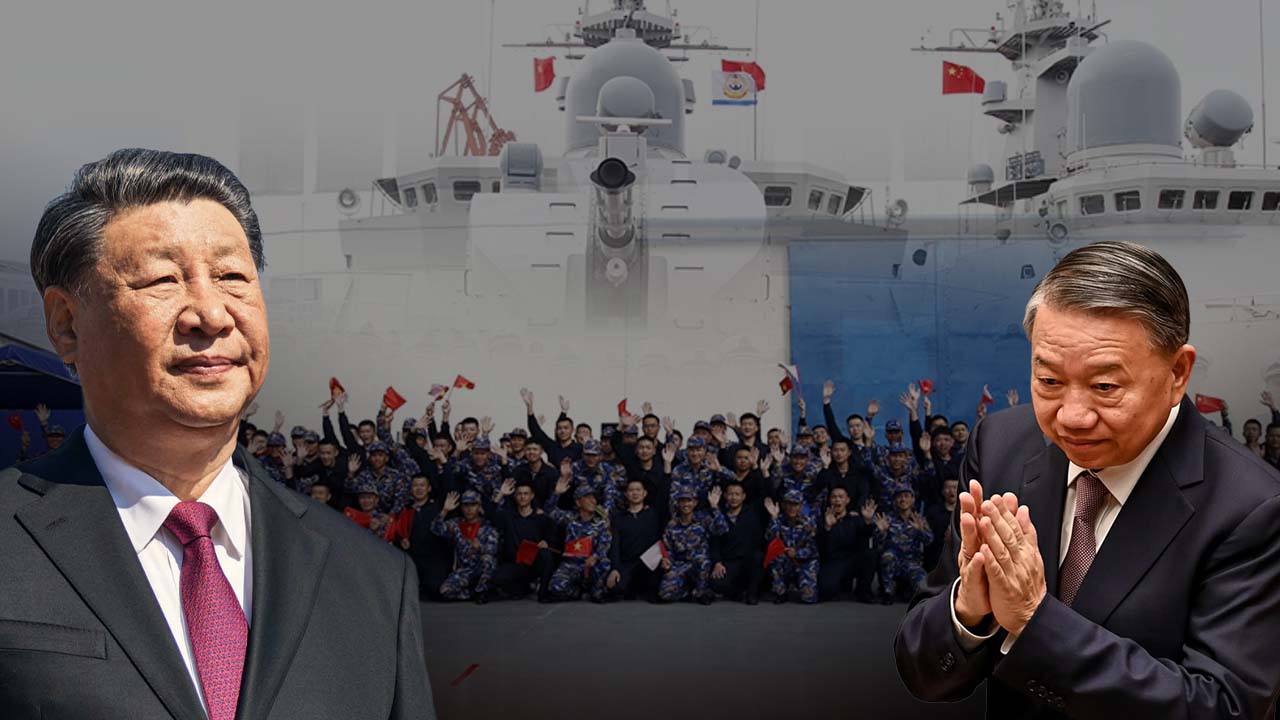
Under the guise of anti-piracy training, the presence of Vietnam’s two most modern guided-missile frigates, 015 Trần Hưng Đạo and 012 Lý Thái Tổ, in Guangxi, China, was far more than a simple friendly exchange.
According to international observers, this is a dangerous and highly risky move, showing a major and unpredictable shift in defense relations between Vietnam and China, despite the fact that Vietnam is a country whose sovereignty has been violated by China through the so-called “nine-dash line” in the South China Sea.
Particularly striking is the astonishing similarity in the military uniforms of the soldiers from the two countries. Images of Vietnamese and Chinese naval personnel standing side by side, nearly identical in every detail, from color to design, have become a troubling puzzle for military observers.
According to this view, this cannot merely be a coincidental similarity in aesthetics, but rather the embodiment of a highly dangerous deep strategy called Beijing’s “dissolution of identity.”
This is said to be a secret defense policy aimed at creating a state of “ambiguity” between Vietnam and China, not only in military matters but also in other “sensitive” areas.
The standardization of the Vietnamese and Chinese militaries raises a vital question: if a real conflict breaks out in the South China Sea, how can one distinguish between the Vietnamese military, defending national sovereignty, and the Chinese invader?
Although Vietnam has long maintained its “Four No’s” defense policy, the excessive closeness between Vietnam and China after the 14th Party Congress seems to be revealing a “fifth piece” of the puzzle, which could be called: “no distinction between the two partners in any form.”
If this hypothesis is correct, it would amount to an implicit confirmation of an excessively close relationship, and perhaps even preparation for a scenario in which “the two become one” under the direction of Zhongnanhai.
This scenario of uniformity could very well be one step in a broader plan to “standardize” the ecosystem between Hanoi and Beijing in all fields, from politics, economics, and social management to the model of state governance.
In the event of major geopolitical upheavals, such similarity could mislead Western partners and make it harder for them to accurately identify the actual party involved in military operations.
However, the price of such “ambiguity” would be the blurring of sovereign boundaries between two distinct nations. In that case, the people’s trust in the independence of the Vietnamese homeland would be fractured and diminished.
In particular, the presence of Chinese naval forces in waters under Vietnam’s sovereignty could gradually be normalized in a subtle way under the cover of coordinated operations.
International analysts argue that Hanoi’s acceptance of letting the image of the Vietnamese military “dissolve” into Beijing’s ecosystem is an extremely dangerous strategic retreat.
Instead of maintaining a distinct identity to affirm its posture as a sovereign and independent nation, General Secretary Tô Lâm’s choice to “blend in” could leave Vietnam vulnerable to falling into the long-term trap of dependence on Beijing.
This live-fire exercise between the two militaries, therefore, is not merely about anti-piracy operations, but may mark the beginning of a deeper transformation, in which national sovereignty is gradually overshadowed by Tô Lâm’s ambiguous calculations toward a “unified” system of governance with China, its gigantic but deeply greedy neighbor.
Tra My – Thoibao.de